


 |
|
 |
|


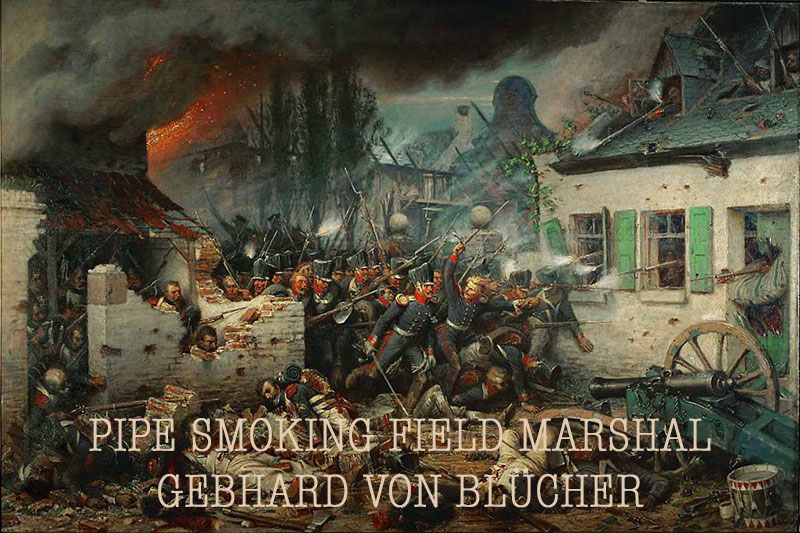
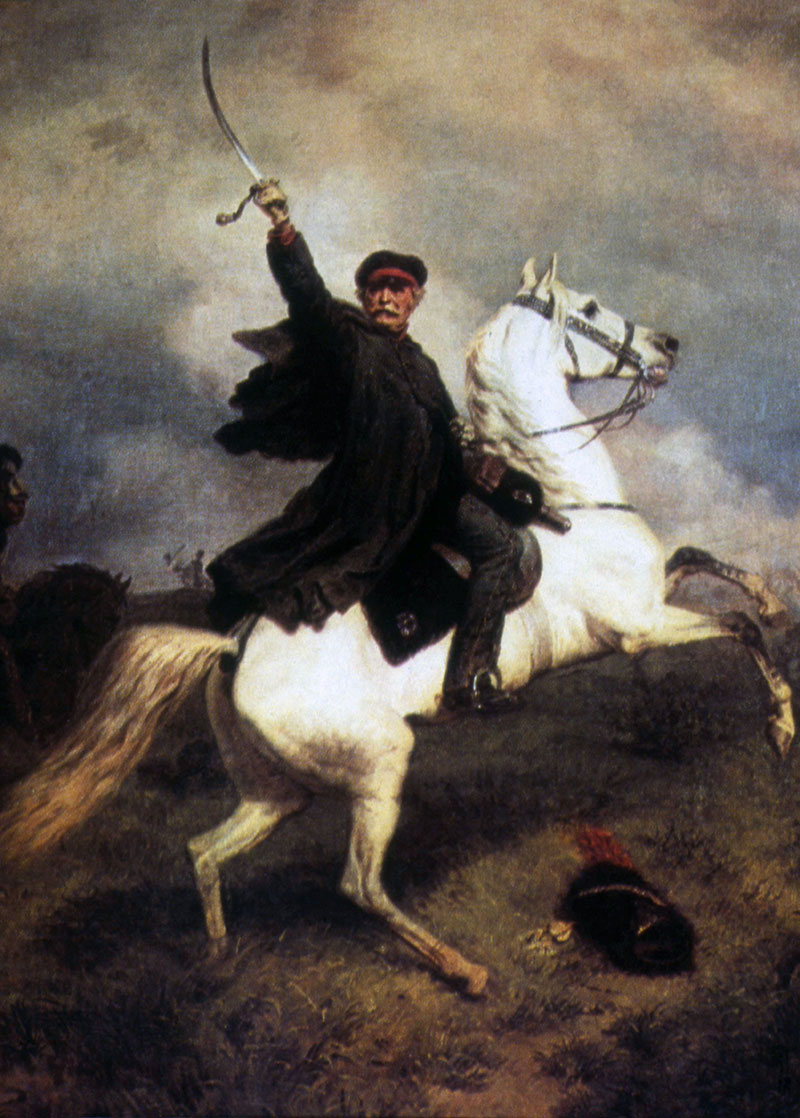
Gebhard Leberecht von Blücher, a highly decorated Prussian Field Marshal best known for leading armies in the French Revolutionary (1792-1802) and Napoleonic (1803-1815) wars, also famously smoked pipes in battle. When outmaneuvering Napoleon, however, minutes count, and he engaged a "pipe-master" whose sole job was to maintain Blücher's pipes, keeping one loaded and ready, even keeping it lit until the Field Marshal wanted a smoke. When on the battlefield, Blücher evidently valued his pipe smoking more than its incidental rituals.
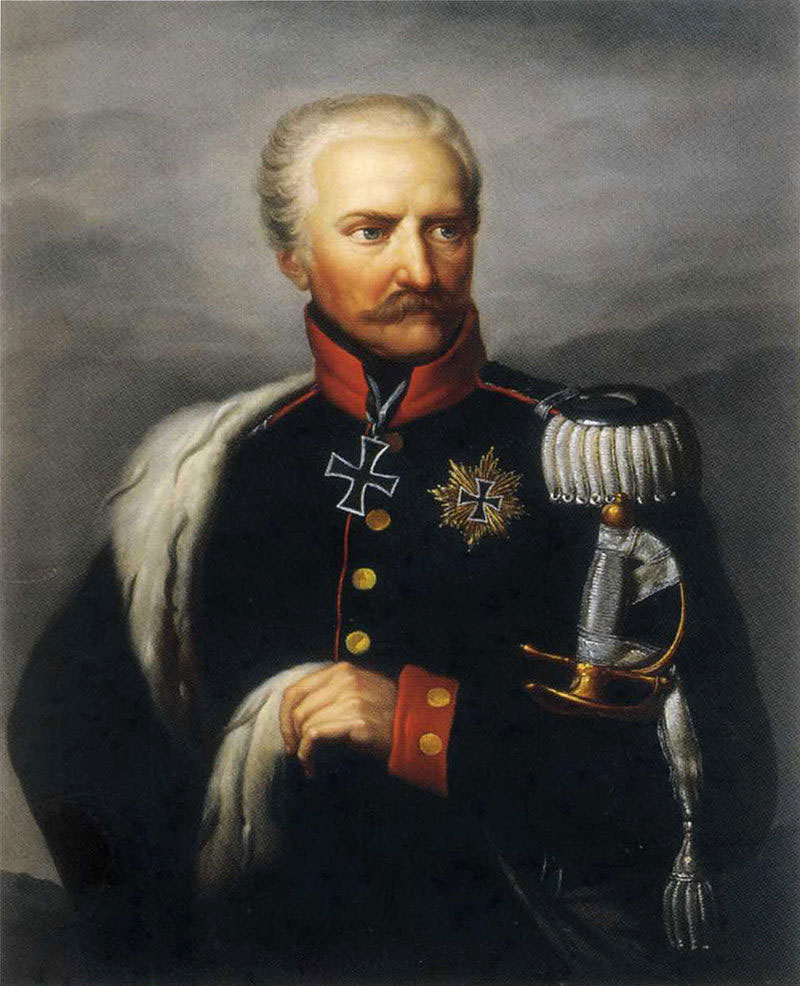
Born in northern Germany in 1742, he began his military career at age 16 by joining the Swedish Army as a hussar, which is a member of the light infantry. Sweden was battling Prussia as part of the Seven Years' War, and the inexperienced Blücher was quickly captured. The Prussian army, impressed with Blücher, offered him a position as a hussar, and he had little loyalty to Sweden — he just wanted to fight. He soon found himself back in the action.
Blücher Resigns
Blücher thrived on war, and when he found himself in peacetime, he had difficulty appropriately channeling his warrior sensibilities. He was dogmatic, unreserved in speaking his opinions, and sometimes exhibited poor judgment, such as when he conducted the mock execution of a priest suspected of supporting Polish uprisings. That stunt hindered subsequent promotion, and he left the army in 1773 after he failed to secure a promotion. He wrote a blistering letter of resignation, eliciting a comment from Frederick the Great of Prussia that Captain Blücher could go to the devil. Burning real bridges may have been a trusted battle strategy, but when applied figuratively, it ruined his military career.
He took up farming and did quite well, but after Frederick died 13 years later, Blücher saw the opportunity to achieve his greatest wish: a return to military service. His reputation as a tenacious fighter and admired leader was intact, and he was reinstated in the Royal Prussian Army with the rank of major and was soon promoted to colonel.
Blücher and the Napoleonic Wars
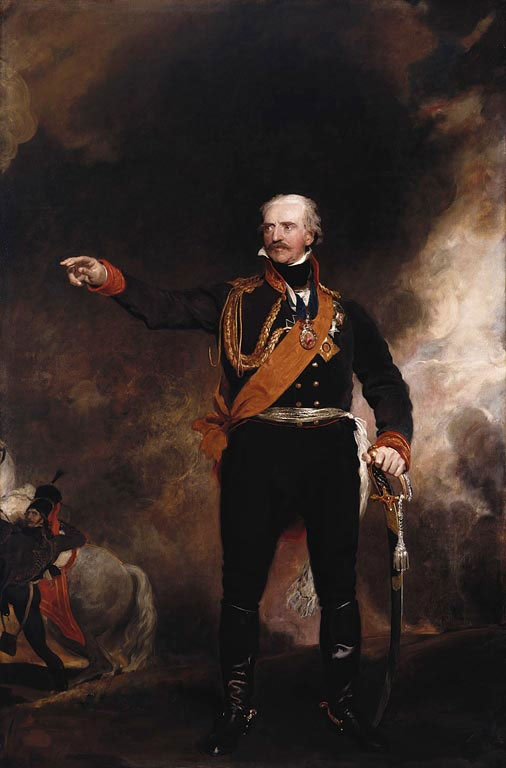
Blücher's reputation rose during the Napoleonic Wars, though he suffered some early defeats. He led charge after charge at the Battle of Auerstedt but eventually had to retreat to the North. He reorganized his forces but was again defeated by superior French numbers at the Battle of Lübeck, and he surrendered only because of diminishing ammunition and supplies. The French allowed him to move freely and keep his sword, and he was returned to Berlin in a prisoner exchange of high-ranking officials.
That campaign ended, but more battles followed, and in 1813 he was made commander-in-chief of the Army of Silesia, leading 90,000 men. It should be noted that Blücher had been given a couple of nicknames. One was "Marshal Forwards," which referred to his aggressive war strategies. The other was "Mad Marshal Blücher." His health suffered as he lost three major battles to Napoleon, perhaps experiencing PTSD. He went temporarily blind and, for a short time, was convinced that he had been impregnated with an elephant. That was alarming, but he got better.
Despite his passion for war and his strategic intelligence, there was no denial that the old general was struggling with his mental health in later life. Physically, his pain tolerance levels were very high, and he could carry on fighting in a wounded state.
However, he also suffered from fits as he approached old age. He was not that stable and apparently suffered from delusions. These often revolved around fear of the French attacking or assassinating him, suggesting a certain amount of traumatic stress from his years of fighting. (Dimri)
He wrote a blistering letter of resignation
He next marched his army toward Paris and was instrumental in defeating the French and forcing Napoleon into exile. In gratitude, King Frederick William III of Prussia made Blücher Prince of Wahlstatt, and Oxford University awarded him with an honorary doctorate.
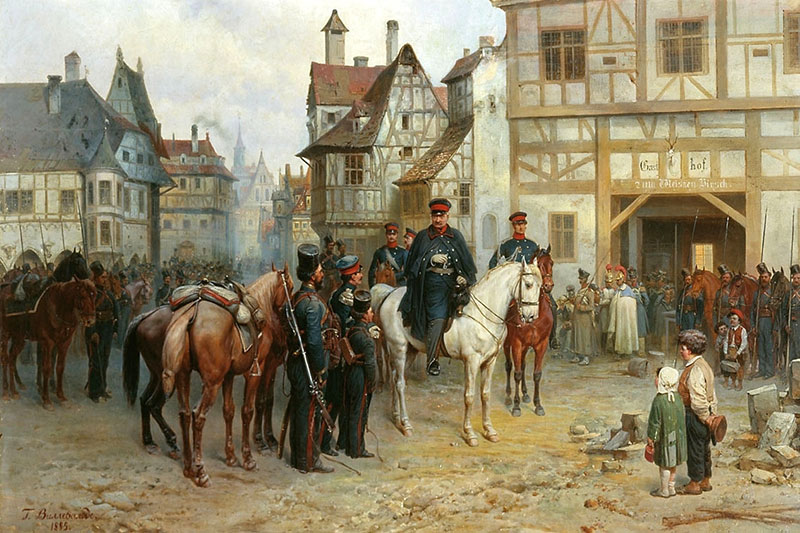
Blücher retired, but at age 70, he was recalled to service when Napoleon reemerged, and he and his pipe-master experienced some chilling times:
Blücher ... had a servant or pipe-master named Hennemann. At the battle of Waterloo, the pipe-master had just handed a pipe to his master when a cannonball caused Blücher's horse to spring aside, and the pipe was broken before the old hero had a chance to take a single puff. "Fill another pipe for me," said Blücher, "and keep it lighted until I come back in a moment, after driving away the French rascals." The chase lasted not only a moment but a whole hot day; then Blücher met Wellington, who asked him about his previous position. Blücher went to the spot where he had halted in the morning. There stood a man with his head bound up and his arm wrapped in a handkerchief. He was smoking a long and dazzlingly white clay pipe. "Good God," exclaimed Blücher, "that is my servant, Christian Hennemann. What a strange look you have, man. What are you doing here?" "Have you come at last?" answered Christian, in a grumbling tone. "Here I have stood the whole day, waiting for you. One pipe after another has been shot away from my mouth by the accursed French. Once even a blue bean [bullet] made sad work with my head, and my fist has got a deuce of a smashing. That is the last whole pipe, and it is a good thing that the firing has stopped; otherwise, the French would have knocked this pipe to pieces, and you must have stood here with a dry mouth." (Manson, pages 26-27)
It sounds like Blücher's pipe-master experienced as many harrowing battlefield circumstances as did Blücher. One has to admire Hennemann's devotion, standing in the midst of a battlefield all day, keeping a pipe lit.
Physically, his pain tolerance levels were very high
Later in the campaign, Blücher's horse was killed, and the 72-year-old Blücher was trapped under the body for hours while the battle continued. He was saved from capture despite being trapped on the battlefield because an aide concealed him under a greatcoat.
Though suffering considerable pain, he then led his army through difficult terrain to arrive at Waterloo, where the battle was dire. It could have gone either way, but Blücher tipped the balance and was instrumental in Napoleon's final defeat.
Retirement
He stayed in Paris for a few months after that, but his age and battle scars finally forced him to retire. He was now a globally admired hero. He did his part for pipe smoking as well, a pastime that had been waning until his visit to England:
As a consequence, smoking reappeared in Britain at all levels of society. While the poor had never abandoned the habit, the rich resumed it. In addition to the examples set by returning officers, society was influenced by visiting dignitaries, including the Prussian General Field Marshal Prince Blücher von Wahlstatt, an ardent pipe smoker, who was seldom seen without his favourite two-foot tube that hung down vertically from his lips to his navel. (Gately, page 152)
Blücher visited Britain with other allied leaders and commanders. A trawl through the British Newspaper Archive confirms that he was the most enthusiastically fêted of the visitors, drawing crowds wherever he went. A satirical poem, "Blucher and the British Ladies," in the Morning Chronicle of 23 June 1814, claimed that he could barely go outside without being mobbed by female admirers. Ladies could also show their admiration by wearing the "Blücher bonnet and spencer" and "Blücher boots and slippers," or by dancing to a "Blücher Waltz." Indeed Blücher's name became attached to many things, including George Stephenson's first steam locomotive and a racehorse which won the 1814 Derby — while the Field Marshal himself looked on. (Reed)
The "two-foot tube" referred to Blücher's German regimental pipes, which he was most famous for, but he smoked a considerable number of clay pipes as well. He retired but lived only four more years, dying at age 76. Given his habit of leading charges himself and participating in the fighting for his numerous campaigns, it's surprising that he lasted so long.
Blücher's Pipe Smoking
Clays and regimental pipes (at least one of them Meerschaum) are the only types we know Blücher smoked, and there is no way of knowing his tobacco. Still, biographies and histories often refer to his pipe smoking.
Blücher's horse was killed, and the 72-year-old Blücher was trapped under the body for hours while the battle continued.
The richest source of information regarding Blücher's pipe smoking is Napoleon and Blücher: An Historical Novel by Luise Mühlbach. Though a historical novel rather than a peer-reviewed history, it contains many details extrapolated from real events, especially in terms of the famous smoker's pipes.
For example, Mühlbach relates an episode in which Blücher is waiting for guests and worried that the winter weather might interfere:
The old gentleman blew dense clouds of smoke from his long clay pipe, and nothing broke the silence save the parrot (in a large gilded cage on a marble pedestal in the third window niche) ... "[I]t snows so thickly that nothing can be seen at a distance of twenty yards. The roads will be blocked up again, and no one will come to us from Neisse today. We shall be left alone, and the time will hang as heavily with us as with a pug-dog in a bandbox. But," he exclaimed, jumping up so hastily that his long clay pipe broke on his knee and fell in small pieces on the floor, "it is all right. If the guests from Neisse do not come to me, I will go to them." (page 85)
Later, again expecting guests, Blücher prepared with the help of his footman:
"Well, John," said Blucher, sitting down again on his easy chair at the window, "now let the men come in. But first, fill me a pipe. You must take a new one, for I broke the one I was smoking this morning."
John hastened to the elegant "pipe-board" which stood beside the fireplace, and took from it an oblong, plain wooden box; opening the lid, he drew a new, long clay pipe from it.
"How many pipes are in it yet?" asked Blucher, hastily. "A good lot, John?"
"No, Your Excellency, only seven whole pipes, and eight broken ones."
"You may ride to Neisse tomorrow, and buy a box of pipes. Now, give me one, and let the hussar and his son come in." (page 93)
In another episode, Blücher is discussing the pipe skills of a footman with the son of his former pipe-master's son, Christian. It's interesting that they touch on the subject of breaking in a clay pipe and perhaps the Delayed Gratification Technique:
"Thunder and lightning! What is the matter with my pipe today? The thing will not burn." And he put his little finger into the bowl, and tried to smoke again.
"The pipe does not draw well, because it was not skilfully filled," said Christian. "I know it was badly filled."
"John has done it very poorly," said Christian, composedly. "To fill such a clay pipe is an art with which a good many are not familiar, and when it is smoked for the first time, it does not burn very well. It ought first to be smoked by someone, and John ought to have done so yesterday if the general wished to use his pipe today."
"Why, he knows something about a clay pipe," exclaimed Blücher, "and he is right; it always tastes better on the second day than on the first."
"He is right," exclaimed Blücher, laughing, "it would surely be better if the second were always the first day." (page 103)
"You may ride to Neisse tomorrow, and buy a box of pipes. Now, give me one
Another interesting conversation takes place when Blücher is explaining the duties of his pipe-master:
"That is a man who keeps my pipes in good order," said Blücher, with a ludicrously grave air — "a man who makes the second my first day — who smokes my pipes first — puts them back into the box at night, preserves the broken ones, and fills them, however short they may be. He who does not prize a short pipe does not deserve to have a long one. A good pipe and good tobacco are things of the highest importance in life. (page 104)
Throughout the book, Blücher discusses the importance of pipes: "What should I do in the field if I could not get a good pipe of tobacco all the time? Without that, I am of no account. But it is necessary to do good service for Prussia, and hence I need, above all, a good pipe of tobacco in the field." (page 104)
Pipes may have been a motivating factor for his pursuit of Napoleon. After breaking his clay pipe against a table when he turned his head too quickly, Blücher said, "It is the second pipe broken today. Well, there will be a day when Bonaparte shall pay me these pipes that he has already cost me. That day must come, or there is no justice in Heaven." (page 275)
He who does not prize a short pipe does not deserve to have a long one.
Blücher's pipes clearly helped him in battle, so important that he went to great lengths to ensure one was always available to him. He spent more than 50 years of his life in military service, and his pipes served with him. It isn't known if Napoleon ever reimbursed Blücher for the pipes he lost fighting him. It's doubtful. But the fact that Gebhard von Blücher's pipes were never far from his mind or his lips demonstrates that he was a dedicated pipe enthusiast. He would have been enormously interesting to talk with, and there's no doubt he would have appreciated the pipe shows, clubs, and artisan makers that we now have.
Bibliography
- Manson, George J. Smoking: A World of Curious Facts, Queer Fancies, and Lively Anecdotes About Pipes, Tobacco, and Cigars (1891)
- Mühlbach, L. Napoleon and Blücher: An Historical Novel (1867)
- Gately, Iain. Tobacco: The Story of How Tobacco Seduced the World (2001)
- Reed, Susan, Lead Curator Germanic Collections. "Waterloo's Prussian Hero: Blücher and the British" (June 2015), British Library, European Studies Blog
- Dimri, Bipin."'Mad' Marshal Blücher: Was the Old Warhorse Really Insane?" (Sept. 2022) Historic Mysteries
You may also enjoy:




Comments
Amazing Story. So I have to come here over the big pond
to read about my own German history.
Great Article.
The real hero is the aid who stood firm with a lit pipe, as ordered, getting wounded, to provide his commander a smoke
Wow what commitment to keep the pipe lit! While fighting! Giving orders burning bridges! Holy smokes!
A hussar is a member of light calvary, not “light infantry”. This is important in the context of pipe smoking, and “pipes loaded and at the ready” - allows the reader to fully appreciate the Field Marshal’s portrayed passion for his pipes and tobacco whilst charging in the saddle. Any infantryman can attempt to light a pipe standing on the ground; but the hussar proves additional required talent.