


 |
|
 |
|



Seattle Pipe Club: The Definitive Guide (with Jeremy Reeves)


Filmed by Nicole Weed and Chris Herath | Edited by Ardit Hushi
We're here today to talk about the Seattle Pipe Club project. As many of you out there know, Seattle Pipe Club has been a cult-classic favorite among the community for many years now, and within the last two years, production shifted from Sutliff over to Cornell & Diehl. We've got Jeremy here today to talk about that process and the project in general. We're going to smoke through some of these blends and give our thoughts on Seattle Pipe Club.
Note: The following transcription has been edited for clarity and brevity.
[Jeremy Reeves]: Sounds like a good time. With the unfortunate closure of Sutliff, this brand, which was being produced by them, came to us. Matt Guss approached us to take over manufacturing for it.
From Sutliff to Cornell & Diehl
This was a learning curve. Thankfully, we were able to get some help from Sutliff. Jonathan Wood, who was the Factory Manager there, was very instrumental in helping us figure out this process. Taking somebody else's manufacturing practices, built around the equipment and space they were using, and trying to fit it into a totally different product structure and production setup is challenging. We're really getting down to some of the fundamental DNA differences between Sutliff's approach to manufacturing, which included a lot more machine processes and general tobacco processing, and the way C&D does things. It was like adding a new step in the middle of a production line and stapling it onto the side. Different press setup, different power source for those presses.
[Steve Mawby]: Specific machinery, all that stuff.
[JR]: Exactly. The shape of the blocks that yield the size of the slices these products are cut in required different machinery, and the blending components were also a learning curve. But it was fun. You get nose-blind to your day-to-day, and this is just the way we do stuff, so it makes you step back and explore everything a little bit. If all four of us were to go and make the same marinara recipe, we'd still have four different results, because we're comfortable with different heats, or we'd use a different sugar, or raisins, or whatever.
[Alan Britt]: I imagine there'd be moments where, going through all these processes to make Seattle Pipe Club as original as possible, you'd pick up on something and think, "I like the way they do that. We should implement that in other C&D products."
New Machinery, Same Recipes
[JR]: Yeah, absolutely. I'm really excited about the cutter design they were using to cut these. C&D has these old Robert Legg cutters that operate on a big wooden wheel, which is the heart of the machine. The mechanism that turns that wheel acts as your conveyor belt, pulling product toward the blade, and it's also the power that operates the blade. There's nothing except gears feeding toward the blade to hold the product stable, and it's always in motion. The cutters Sutliff was using are more modern, and admittedly less romantic.
But there's this really cool mechanism where, before the blade cuts, a little arm behind it comes down and holds the product steady. Then it cuts, the arm raises, the blade raises, and the product advances whatever width you're cutting at. It yields a much more structurally stable product, which we've found works really well on our flakes too, since our curved blade always gave us the classic C&D slice. But this machine totally transforms the structural integrity of the flake.
[Andrew Wike]: For some context at home, any time a brand you know and love switches manufacturer, there's always concern about continuity and preserving the same essence. What I think is really interesting here is that it's all the same. We're using the same machinery and the same recipes. It's exactly what you'd expect from Sutliff, just made by Cornell & Diehl, which is really cool.
[AB]: I was just going to compliment how, if I had a five-year-old tin of this next to a fresh tin, I'd be able to tell from the cut alone that it was made differently. I'm smoking Hogshead, which is my personal favorite in the Seattle Pipe Club portfolio. Straight Virginia. I always get this vanilla ice cream creaminess to it, which is odd, but that's what I taste. For an all-day Virginia blend, I really enjoy it.
[SM]: I'm also smoking Hogshead, and I'll say this tastes a hell of a lot like I remember it tasting when it was Sutliff-produced. You've done something here that's very true to the original blend. The Seattle Pipe Club stuff was actually originally produced by C&D back in the day, right?
A History Written on Rolodex Cards
[JR]: That's right. Mississippi River and Plum Pudding. The Special Reserves and Hogshead were added later, but the original recipes for Mississippi River and Plum Pudding I actually have in my old C&D Rolodex, which is how they kept all the recipes back in the day: handwritten on Rolodex cards.
[SM]: Cutting-edge technology.
[JR]: In a weird code that required a lot of archaeology.
[AB]: CIA decipher.
[JR]: I would try to go back and figure out what these things meant, using recipes that didn't quite follow the same formula, and slowly piece it together.
[SM]: So the Tarlers were worried a lot about corporate espionage.
[JR]: I think that was where Craig Tarler was coming from, but he did a really good job. Joe Langford's name is on these cards, and a lot of C&D's blends were actually born out of customers calling and saying, "I've got this idea for a blend, it's this and this, would you make me two ounces of it, a pound of it?" You could even ask for it to be pressed. That kind of customization is really how our massive catalog came to be, and Joe Langford was one of those customers. He's also behind Bayou Morning and Bayou Night.
[AW]: Wow, that's super cool.
[SM]: That's amazing.
[AW]: So it all comes full circle. That's really interesting.
[JR]: It's like a weird homecoming. This was a long time ago, back in Morganton, NC, still in the days of operating out of the Tarlers' house. Very early in the days of selling pipe tobacco online, and in the earlier days of C&D. My guess would be '96, '97, somewhere in there.
[AB]: So you guys are smoking the flagship product, Plum Pudding. What are your thoughts?
[AW]: I think it's a really nice, all-day English blend. There's a sweetness to it that reminds me of things like Frogmorton and some of the McClelland Englishes. They're not one-to-one, of course, but there's a similar sweetness there. It's not quite as dry as some Englishes, but it holds up really nicely, and it's burning well.
Plum Pudding is an interesting product. It's sort of the flagship, but it's also one of the first blends Joe actually made for the club. Joe was connected with the Tarlers and was always home-blending his own little recipes. The folks at Seattle Pipe Club told him he should blend something for the club, and from what I remember, he was resistant. He was a humble guy: "I'm doing this for myself and my friends, for my community." But, of course he shared Plum Pudding, and everyone said, "Joe, this is super good, we have to share this with everyone."
[SM]: All of a sudden he had a lot more friends.
[AW]: He did. And I think that's the cool thing too: when we smoke Plum Pudding or Mississippi River, we get a bit of Joe, his mind, his creative process, what he was going for, and we get to experience that today, years after he's passed. Plum Pudding is a really good blend.
[AB]: I tend to be a sentimental guy. I think it's really a service to Joe Langford's legacy that pipe smokers worldwide can smoke Plum Pudding and have a little piece of him. Cornell & Diehl being able to continue that, I feel honored to be even a small part of it.
[AW]: A little piece.
[AB]: Just the tiniest of pieces, meaning I might walk into Cornell & Diehl every now and then.
[SM]: Just sniffing a jug of the Mad Fiddler Flake topping. I think that's an excellent point, and it's one thing C&D, and Laudisi more broadly, does very well: stewarding history. There have been a lot of projects where we've taken on things that have a lot of historical context that might not have a home otherwise and would fall by the wayside, and this is a really good example of stewarding a lot of history.
This started at C&D in the Tarler days, went through McClelland at one point, then Sutliff, and now it's back at C&D, the last major American pipe tobacco manufacturer. All coming full circle, like you said, Andy. There's a ton of history here, and you guys are doing an awesome job of keeping it going.
[JR]: Thank you. We had a lot of help from Jonathan, who's been huge all over the place. It's been really cool to just be another set of hands in that long line of hands that kept these products going.
[AW]: It's a culture of continuity, right?
[JR]: It is.
[AW]: Also in the line, there's Mississippi River.
[JR]: Yes.
The Dream Behind Mississippi River

[AW]: That one's really cool, actually. I was talking with Matt Guss once, and he told me how Mississippi River came about, and it sort of mirrors a lot of creative processes I've read about, like Dali or Einstein catching the right idea just after a dream. The recipe for Mississippi River actually came to Joe in a dream.
[SM]: Oh, wow.
[AW]: He was falling asleep one night, and it popped into his head, "What if I did this and this?" The next morning he woke up, wrote it down in a little journal, blended it, and shared it with the Seattle Pipe Club guys, who said, "Oh my God, this is crazy." It's really interesting how the dream state inspires a lot of artists.
[SM]: That's very cool. I wish my dreams were anywhere near that productive. I wake up in the middle of the night, write notes frantically, and in the morning it's just gibberish, or "You should cook ribs in the morning."
[JR]: I've also had that experience of thinking lightning struck, then wondering, "What was I even talking about?"
[AB]: I would love to dream about tobacco. I never dream about tobacco.
[SM]: That's surprising. I figured you'd have tobacco dreams pretty much nightly.
[AB]: Me too. That makes me really sad. I don't dream most nights. There's nothing.
[SM]: That's sad. You need some dreams, Alan.
[AW]: You probably do. You just don't recall them.
[AB]: It feels like I just slowly fall into an endless void, man, most nights.
[SM]: Don't we all?
Where to Start with Seattle Pipe Club
If you were someone just getting started with Seattle Pipe Club and wanted to explore a little, where would you direct them?
[JR]: I think going with the original blends makes the most sense, because you can see the progression of the whole brand. Plum Pudding and Mississippi River, I forget which came first, I think it might have been Mississippi River... Either of those are good introductions. There's a smoky, tangy flavor tension you find through the whole line, something that really struck Joe, and you can see it carried through in everything else he did.
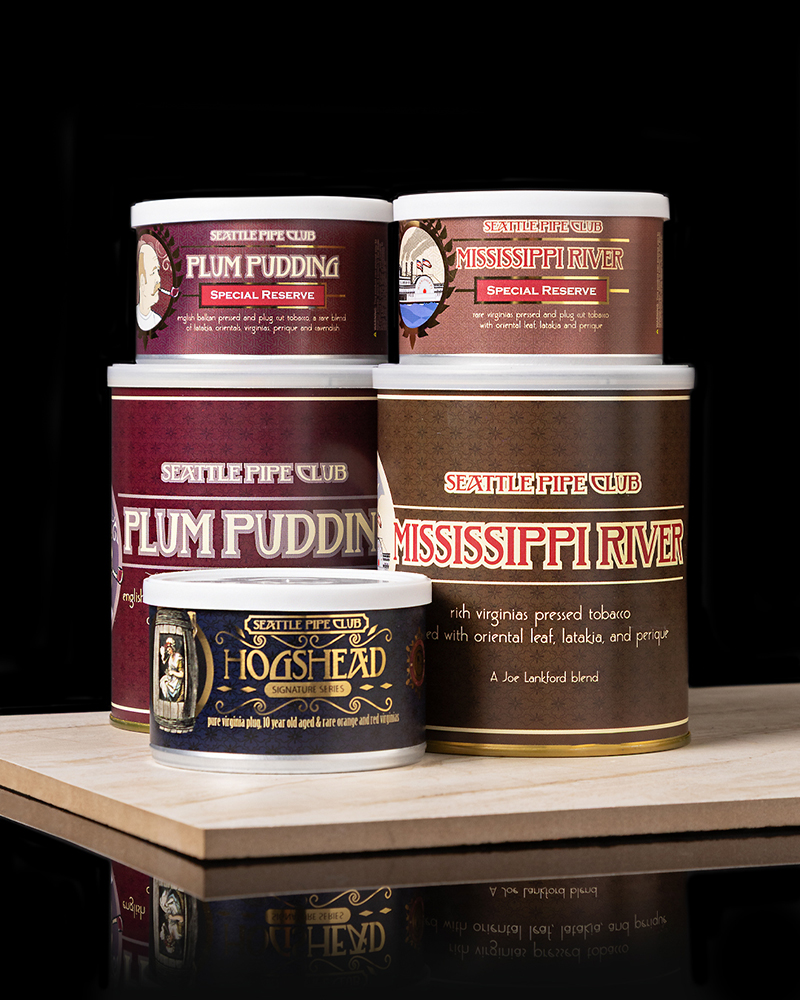
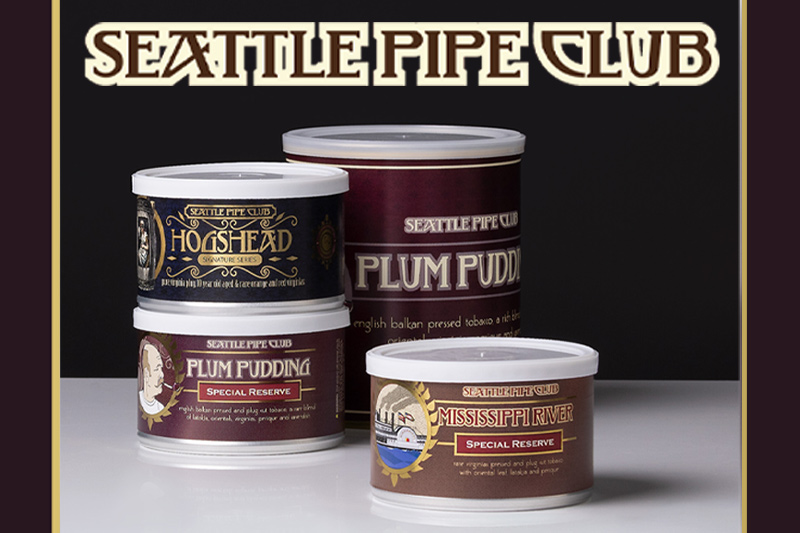
It's interesting, too: these are basically the same components, but inverted in proportion. Mississippi River is much more Virginia-forward, with hints of Latakia, Perique, and Black Cavendish, whereas Plum Pudding is heavier in Latakia and Perique, with the Virginia taking a back note. Both are offered in eight-ounce tins, and then there are the Special Reserves — Mississippi River Special Reserve and Plum Pudding Special Reserve — offered in an aged cake.

There's also Hogshead, a pure Virginia blend that's mellow, fruity, and sweet — a classic Virginia flavor profile. We also do a barrel-aged version of Mississippi River and Plum Pudding, another interesting process, since we had to figure out how to press tobacco into a barrel without being set up for it the way somewhere like 31 Farms is. Each blend is aged in a single-use barrel for 30 days: whiskey barrel for Plum Pudding, rum barrel for Mississippi River.
[AB]: C&D just hasn't dealt in barrel-aging blends before, so figuring out that process, I look forward to hopefully implementing it with some C&D blends too. Barrel-aged Mad Fiddler Flake, just to pick a random one.
[AW]: We can get you a barrel.
[AB]: Overall, it speaks to how hard the folks at C&D tried to make this as close to the original product people know and love. It's a labor of love.
[AW]: Jeremy, thank you so much for joining us and talking about Cornell & Diehl's expressions of these cult-classic blends. Thanks to Matt Guss and the Seattle Pipe Club as well for working with Laudisi and C&D on continuing this project. We're really excited that we can keep this going, and that customers who love Plum Pudding can keep loving Plum Pudding for many years.
Thanks so much for watching. Be sure to drop us a comment and let us know what your favorite Seattle Pipe Club blend is, and if you've tried some of the C&D stuff yet. We'll see you next time.
You may also enjoy:




Comments
Still waiting on that Bold Kentucky replacement Jeremy
You guys are heroes for saving SPC blends. SPC was just a huge scare that all of us thought we lost when Sutliff closed. We can talk all day about these blends and how much of a genius blender Joe was to come up with these blends. Blending 5 different leaves to come up with SPC Plum Pudding? Amazing. Enjoyed watching the video and thanks to all for the hard work on continuing SPC blends. Love SPC.