


 |
|
 |
|


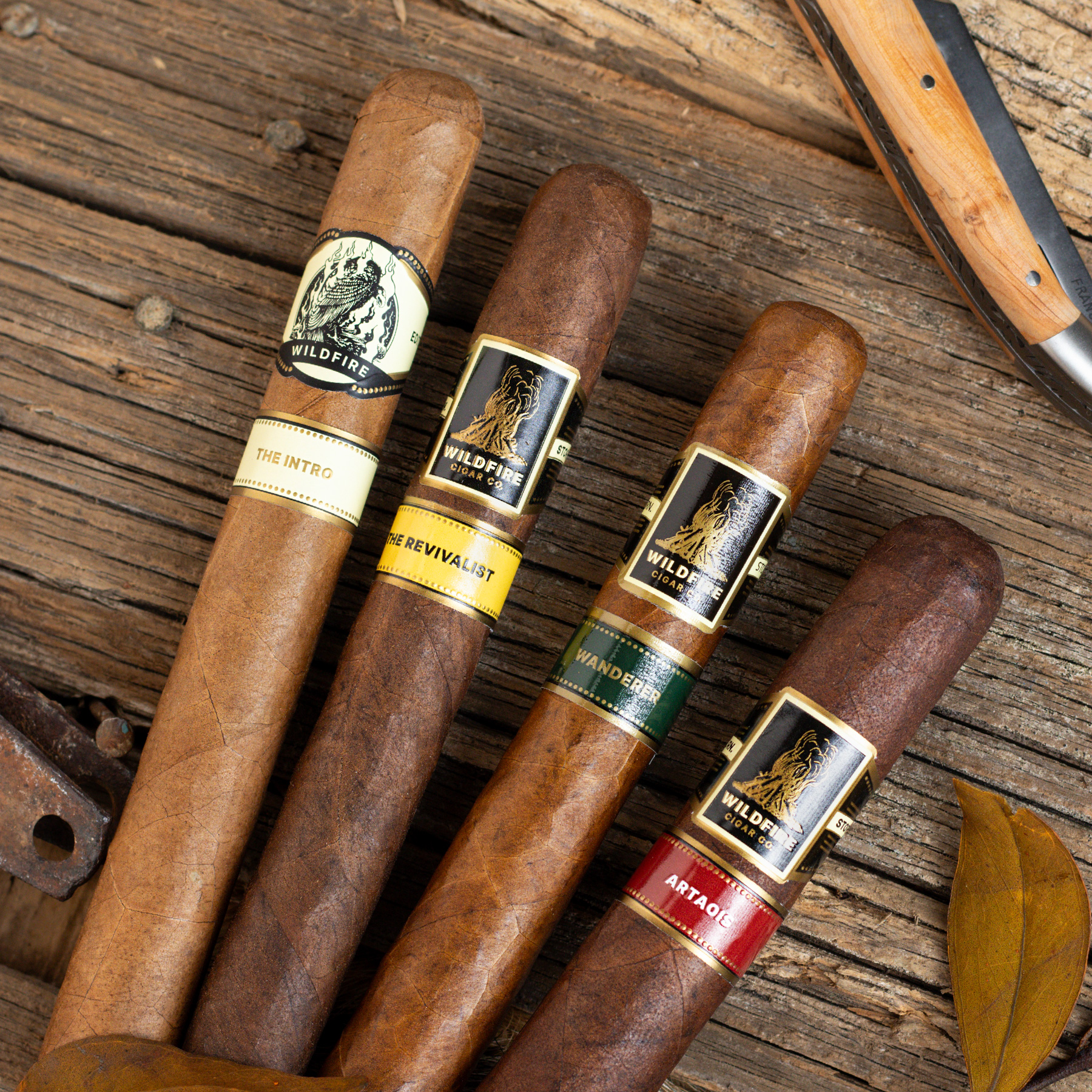
Welcome to another episode of Smoke Rings. Today I'm chatting with Jeremy McDonald of Wildfire Cigars. Tune in as we discuss Jeremy's journey as a young boy who longed to smoke cigars with his uncles into a man owning his own cigar brand, releasing a variety of cigars, including The Revivalist and The Intro, a limited-edition cigar that is the first of a three-part series from Wildfire Cigars.
Note: The following transcription has been edited for clarity and brevity.
[Truett Smith]: Hey, everyone. Truett here with Smoking Pipes, and I'm joined by Jeremy McDonald, founder and owner of Wildfire Cigars. Jeremy, thanks for being here. Welcome to Smokingpipes headquarters, and we're happy to have you here.
[Jeremy McDonald]: Thanks for having me.
[TS]: We introduced Wildfire Cigars to Smokingpipes earlier this year, and it's great to have Jeremy in-house now, but I'll let you take over, and just talk a little bit about what got you into cigars, when you founded Wildfire, and what that journey looked like.
[JM]: Sure. Well, we'll start here. I got into cigars because growing up, every holiday, my two uncles sat on the porch and smoked a cigar. No one else in my family smokes. But as a kid growing up, I thought like, man, that's so badass. And I was like, dude, I want to smoke with these guys. And so I would ask my Uncle Glen, "can I try it?" And, you know, he's checking to make sure my mom's not looking, and would let me, and I thought one day I'm going to join these guys. One of my uncles passed away when I was a young teen, and then, when I turned 18, on my 18th birthday, I went to 7/11 and bought a Garcia y Vega three-pack. I think Candela, cause I had no idea, right?
[TS]: Perfect intro cigar, right?
[JM]: And a Snapple.
[TS]: Yeah, nice.
[JM]: I wasn't even 21. So I sat in my backyard and thought: I found it, man, I love this. And I didn't even know about cigar shops or tobacco stores, I just thought you go to 7/11 and get 'em.
[TS]: Right.
[JM]: And I think even for my first holiday that came after that, which was, I guess, Easter, I probably brought Garcia Vegas to my grandma's house for me and my uncle. He smoked Fuente Short Stories, so I found out.
[TS]: Yeah, yeah. He had a little different taste then.
[JM]: Yeah. So then we smoked on the porch, and I loved it. For me, it was something like love at first sight. Obviously the first cigar I smoked was kind of trash, but the experience of it...
[TS]: And the familial aspect, communal aspect, it was kind of like a coming of age type of a moment?
[JM]: Yeah, yeah. I turned 21 and I didn't care. 18 was when I got to get my first cigar.
[TS]: That was a milestone.
[JM]: I went in, and my first premium cigar I purchased was a Henry Clay, I think. Pretty sure. I just fell in love with it.
[TS]: How'd you then get into the industry? You know, you're 18, you become an aficionado. What gets you into the industry then, not just as an enjoyer of cigars?
[JM]: So, I had a champagne taste on a beer budget. Like, I loved cigars, but I had no money. I was making slightly above minimum wage, and I wanted to smoke more cigars. So by this time, I found cigar shops pretty rapidly after.
[TS]: And this was where you grew up in California?
[JM]: Yeah, in California. So I had a few shops that I would float around to. And I just thought, man, this is such a cool industry. Although what's funny is, I didn't hang out at the shops. I just bought cigars and left, because I loved cigars, but I was super intimidated by the culture. I didn't wear a tie, I worked at Trader Joe's, and I was in a punk rock band. Like, that was not my world. And then the shop owner invited me to stay one day. He was like, "hey, I want you to smoke a cigar with me." And I fell in love with it, because I started talking to guys, and there were doctors, lawyers, unemployed guys, construction workers, whoever it was, and we just started having conversations. And so I thought, I really like this.
So I said, "hey, if you ever need any help, I'm always down for a second job." And at that point, I think it was around six months later, the RTDA — which then became IPCPR — so the RTDA, they were like, "hey, we got to go to the trade show, would you want to watch the shop?" So I took a vacation from Trader Joe's, and then I worked there, and I never left. I just fell in love with it, it was everything about it: the culture of it, trying different cigars, trying to understand nuances — I was fascinated by the whole thing.
[TS]: How do you go from there to, was it ever on your radar early on to think I really want to make my own cigars? Or did that come later? What experience made you want to start your own brand?
[JM]: Honestly, it felt like a natural progression. So I went from working in retail; I worked there 11 years, and then I started repping, because I thought there was not much of a future for me on the retail end unless I was going to open my own shop, which I did not have any interest in doing, nor did I have the money to do it. So I started repping. And then, through the repping, I ended up working with Robert Caldwell when he was with Wynwood, under the CLE umbrella. It was the first cigar in the portfolio that the cigar geek in me loved, you know, because it was a super cool brand — the whole concept. So Rob and I spent a lot of time together. I was with him when he broke away and quit.
[TS]: And started Caldwell?
[JM]: Yeah. Well, he quit, and then didn't know what he was going to do, but then he asked, "do you want to do this with me?" And I was like, "yeah, I do." So I jumped ship, and then I worked for him for eight and a half years, and somewhere in there, I was getting poached from other companies to do national sales manager stuff. But I kept telling Rob and the other owners that this was my last rodeo. I thought, I'm done in this industry from here. 'Cause I didn't want to make a lateral move. I really enjoyed my time at Caldwell, but I figured this couldn't be replicated in company XYZ.
And then, I started thinking about it. And I called up Rob, and was like, "dude, I think I want to start my own." And he said I should, so he and I knew about it way before anyone else. So I started to think, I want to get a factory on board. I specifically wanted to work with Joya de Nicaragua. They were the first factory I toured when I was a retailer. I was brought there on a Nicaragua trip. And I don't know, everything about them I loved, and I loved that they don't work with a million brands.
[TS]: They're selective, yeah.
[JM]: Yeah. So I reached out to Juan Martinez, and it's funny because when I talked to him, he thought I wanted to make a lost and found project.
[TS]: Okay.
[JM]: Yeah. And then I was like, "no, no, I want to build my own brand." And he asked, "is this on the up and up? Like, does Robert know about it?" And I thought it was funny, because he was so concerned about whether I was doing this behind his back.
[TS]: He was the first one you told about it.
[JM]: And so that journey began of working on the blends. And it happened during COVID-19, so I could not go to the factory. So The Revivalist, the one you're smoking, was the first blend we released, but we had to do that entire thing by back and forth mailing it, tweaking it each time. So it was a very lengthy process, but it was the only way we could do it, 'cause I couldn't go to the factory.
[TS]: So The Revivalist, the first cigar, when did that come out?
[JM]: So that launched and hit the market in September of '21.
[TS]: '21. Got it. And since then you've released how many cigars in the Wildfire portfolio?
[JM]: We released two other Core Lines, and then I have an LE out right now.
[TS]: And that one's called?
[JM]: The Intro. And that's the first of a three part series I'm doing. It's fun takeoffs of different spin offs of traditional cigars. The Intro is an Ecuadorian Connecticut, but it's got Corojo binder, it's got Pennsylvania Broadleaf, it's got Estelí. And when I was messing with that ... this is actually made out of another factory, I should mention that, too. That's FTC, which is the Cavalier factory in Honduras.
[TS]: Core Line is made at Joya, and then the LE, The Intro, is made at Cavalier.
[JM]: Yeah. And that's kind of what I wanted: the bigger picture is that I want to use Joya for my core, and I want to go to different factories, like all over, and work with 'em just so I can get different styles of cigars and different tobaccos to work with. I didn't want to make a Connecticut, because the bar is way too high for them. I mean, you go down the list, and I figured if I'd go to the polar opposite end of the spectrum, I could make something that's kind of gritty, and heavier, and it still works with the Connecticut tobacco ... that could be fun. So that's kind of the concept of —
[TS]: A bolder version of Connecticut.
[JM]: Yeah. Which, no, I'm not the first guy to put out a bold Connecticut, but I wanted to just make something that seemed like a much smaller wheelhouse to play in than smooth, creamy, grassy, whatever notes you want to say. I didn't want someone to think I was trying to make the Eastern Standard, or a Davidoff, because I cannot make an Eastern Standard.
[TS]: No, and that's not what your brand's trying to do, it's not trying to repeat everything else. In terms of the Wildfire name and the brand; your website builds it as a fun, campy sort of vibe. What inspired that? Growing up, were you in summer camp a lot? What's the outdoorsy motif inspired by?
[JM]: Yeah, I mean it's definitely fun, and kind of tongue in cheek, but at it's root, it's a pretty simple concept. The campfire is more of a staging ground. People sit around a campfire, they talk, they hang out, they have conversations while smoking cigars. And that's the aspect of the brand that I really love. So I thought, I want everything centered around a campfire. I also wanted the branding to be clean. I wanted the branding to speak for itself. But then the marketing, I thought, let's have some fun with this, right? Since we've got the campfire, the camp counselor gets introduced, and at the trade show, I made '70s ringers that were like a camp counselor. And everyone in the booth that was helping me recognized that there was an arts and crafts director.
[TS]: Yeah. In your booth this year was a literal camper trailer.
[JM]: Yeah, yeah. And it's funny 'cause it won.
[TS]: It won the best booth of the show. Yeah.
[JM]: Absolutely hilarious.
[TS]: That's awesome.
[JM]: Chicken with Christmas lights on a trailer and won.
[TS]: That's awesome.
[JM]: Not intended to win, or even thinking that that was going to be part of it, but I mean, it was cool.
[TS]: Then you packed it up and you traveled the country in it, too, which made it all the better.
[JM]: Yeah, yeah, which I'm out in right now. People kept going, "are you actually going to be in that trailer?" And I'm like, "yeah. It's going to be my home for a long time."
[TS]: So you're living Wildfire cigars. You're not just marketing it as Wildfire, with camping, cigars, whatever — you're living that lifestyle.
[JM]: Yeah. And I mean, there's so many good cigars out there, right? If a brand is going to work, it has to be an authentic thing, right? So the things to me that I love are having interactions with people; I love camping, and I love music. All those things are combined into the branding. The Intro has — you're not going to be able to see it — but it has a clef note, a G clef note on it. I enjoy the aspects of combining all the worlds. And it's fun. 'Cause this past weekend, I went to a punk rock festival, and ended up running into cigar guys, and we were having conversations, and then some of the bands from back in the day that I grew up listening to, I was having conversations and smoking cigars with them, and they were smoking. And so it's basically all the worlds collided into this.
[TS]: All of your interests and your passions are melded into these cigars.
[JM]: Yeah. And so, I feel like I wanted a brand that was authentic, right? I didn't want it to be like, this guy looks like he's in a plane, and he's a world traveler, when really, I'm a trailer traveler.
[TS]: And like you said earlier, too, originally being intimidated by the suit-and-tie sector of the cigar industry, it wouldn't have been authentic for you to start a brand and start dressing like that. You wanted to do something that was you.
[JM]: No. People were saying, you can't, but I mean people have said that the whole way along. When I was a national sales manager for Caldwell, people were like, you need to wear a suit. And I was not going to wear a suit. People aren't going to take you seriously. I'm like, they'll take you seriously. They will. Maybe they won't, but...
[TS]: But that's on them. That's not something you've got to then change about yourself.
[JM]: And then, when starting this, I knew I didn't want to be a character. You know what I mean? In this industry, I don't want to be someone that has this perception of being larger than life, 'cause I'm not. I'm a normal Joe Schmo. So I don't want this mystique around me. There are certain characters in our industry ... I'm not going to name 'em, but they're just personalities. And they can be really cool guys, but it gets caught up into it being that there's something more than just a dude that makes cigars, and I just want to be a dude that makes cigars. And I want to make it healthy enough to pay my bills and enjoy what I do.
[TS]: I think that's really refreshing. And ever since we've brought Wildfire on, we've all loved them here at the office. I think Revivalist is my current favorite, so check that out. Give us a rundown of the portfolio and what flavor profiles people are going to expect from the different lines.
[JM]: So The Revivalist is going to be an ode to old-school Nicaraguan cigars. So it's more earthy and woodsy. It's not a spicy cigar. You get notes of cocoa, but to me, it's like a throwback cigar. A little more rustic. But it's what I fell in love with with cigars.
[TS]: There's some sweetness, too, like the cocoa, that's what I like about it.
[JM]: Medium-bodied, just every day. Then the second line I debuted was the Wanderer. This has got an Ecuadorian Sumatra wrapper, with Nicaraguan Habano binder, and then it's got tobacco from Paraguay, Estelí, and a little bit of Broadleaf in here. And this is much more chocolatey, and very rich, but not heavy on the pallet. It's still an everyday cigar. I'm not overtly into very spicy cigars. There's a time and a place for 'em, but that's not typically my go-to. I think that ethos came about 'cause I used to smoke bolder Nicaraguan cigars before working with Robert, but then I got into the nuances and complexities of cigars.
[TS]: He'll turn you away from that pretty quickly.
[JM]: Yeah, for sure. And it's something that resonates with me, but I love Nicaraguan tobacco. I can only do something that, as long as I like it, hopefully, another person likes it. So that's the Wanderer. Then you got the Artaois, which was the newest release at PCA this year, and that is a Nicaraguan Habano Oscuro over Indonesian binder and all-Nicaraguan fillers. So this is a meaty, hearty, still not overtly spicy, but it's edging on full body, and it's going to hold up to ... well, I smoke everything with coffee. But if you wanted barrel-strength whiskeys, or after a steak dinner, it's hardier.
[TS]: Artaois is going to hold up with something like that.
[JM]: And then, the Intro, which I said is the first of my three part series. I already explained the blend, but that's more spicy. It's my spiciest cigar.
[TS]: That's the Connecticut?
[JM]: Yeah. Not the strongest, but it's got some pepper, like red pepper, to it, and some woody notes. It's not really creamy whatsoever, but it's not overtly strong. Anyone who enjoys the medium realm can like it.
[TS]: So basically, if someone maybe hasn't gotten super into Connecticut-wrapped cigars, because they tend to be on the creamier, smoother side, if they like spicy stuff, they're going to want to pick up The Intro.
[JM]: Yeah. And I think it's a fun way of presenting something that's known for one thing in a different manner. So, like, a Connecticut for a guy that may typically not smoke Connecticuts. Or a Connecticut, if a guy wants a Connecticut that can hold up after he's had two cigars already. So, it's just a fun —
[TS]: Re-imagining of the genre. Very cool. Well thanks so much Jeremy for being here, and thank you all for watching. Go ahead and check out Wildfire cigars at Smokingpipes.com. We've got all of these available now, and we'll see you next time.
You may also enjoy:



Comments