


 |
|
 |
|





Today, we're going to be talking about one of our favorite varietals — Burley. How it's used, what our favorite blends in the category are, and maybe some little Easter eggs for what might be coming up soon.
Note: The following transcription has been edited for clarity and brevity.
C&D and Burley
[Alan Britt]: Truthfully, C&D is synonymous with American-style Burley blends. When the masses think of C&D, you think of things like Briar Fox, Haunted Bookshop, and Old Joe Krantz — that style of blend that's become super popular and super synonymous with C&D.
[Jeremy Reeves]: I think a lot of it had to do with the kinds of people present in the early days of C&D collaborating on blends. Bob Romanowski is credited for a lot of the really Burley-elevated, codger-style blends — Haunted Bookshop, Old Joe Krantz, and Pegasus. Bob and William Serad were friends with the Tarlers and were really interested in the way they were already using leaf and developed a bunch of blends for C&D that featured Burley heavily. Along the way, Craig really came to love Burley.
Burley can be divisive. It has sort of a perception issue — maybe because it's commonly seen in codger blends. People may turn up their nose at something like Prince Albert or Carter Hall. Those blends are cool and historic, but the way C&D was using Burley was really putting it in the forefront in a way that a lot of other blending houses don't.[Andy Wike]: So everyone's using Burley, but C&D made it a prominent, main component of their portfolio.
White Burley vs. Dark Burley
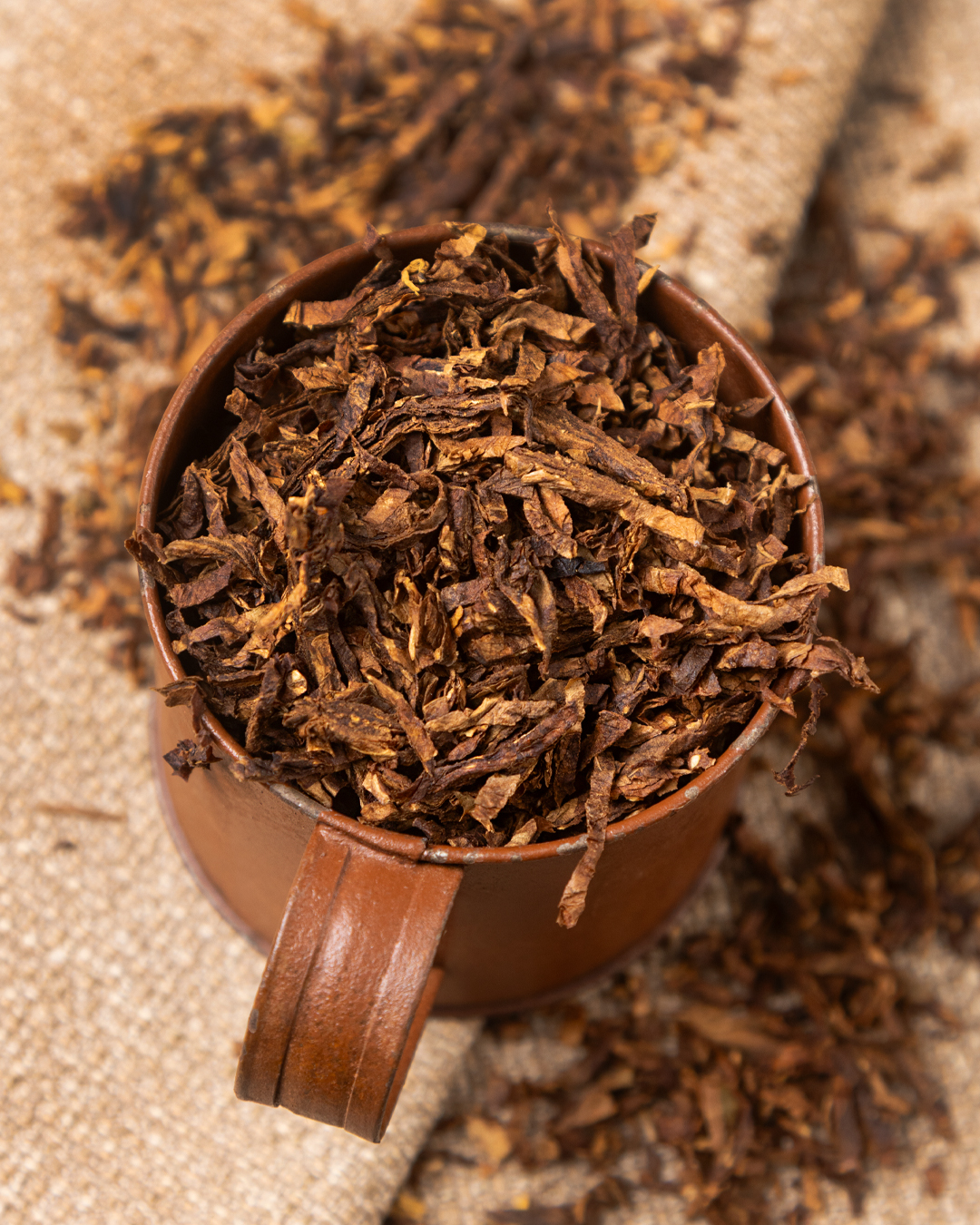
Dark Burley
[AB]: We hear those terms frequently, but what exactly is the difference between White Burley and Dark Burley?
[JR]: They can come from even the exact same plant — like Bright and Red Virginia. Your lighter air-cured leaf is from lower down on the stalk, while Dark Burley is more mature, usually higher up. In US tobacco, we also call it dark air-cured, and it's basically what we'd refer to as Ligero in cigar tobacco.
You'll note that Burleys a lot of times have a cigar note to them, even though you're talking about tobacco typically grown in Pennsylvania, Tennessee, Kentucky, or Maryland. That common note really has to do with the fact that most cigar leaf is also air-cured. Burleys in general don't have a whole lot of natural sugar; they don't need it because they're typically grown in rich black soil. White Burley always reminds me of coffee with cream and maybe a dash of black pepper. It's not sweet, but there are unsweetened cocoa notes, a little cedar here and there. It's really nice and pleasant, but it's very monotone once you see what all the flavor has to offer — it just holds that the whole time. So a lot of times in Burley blends you use Virginias to lend some contrast and some sweetness, because Burley can't do it on its own.Nicotine, pH, and Tongue Bite
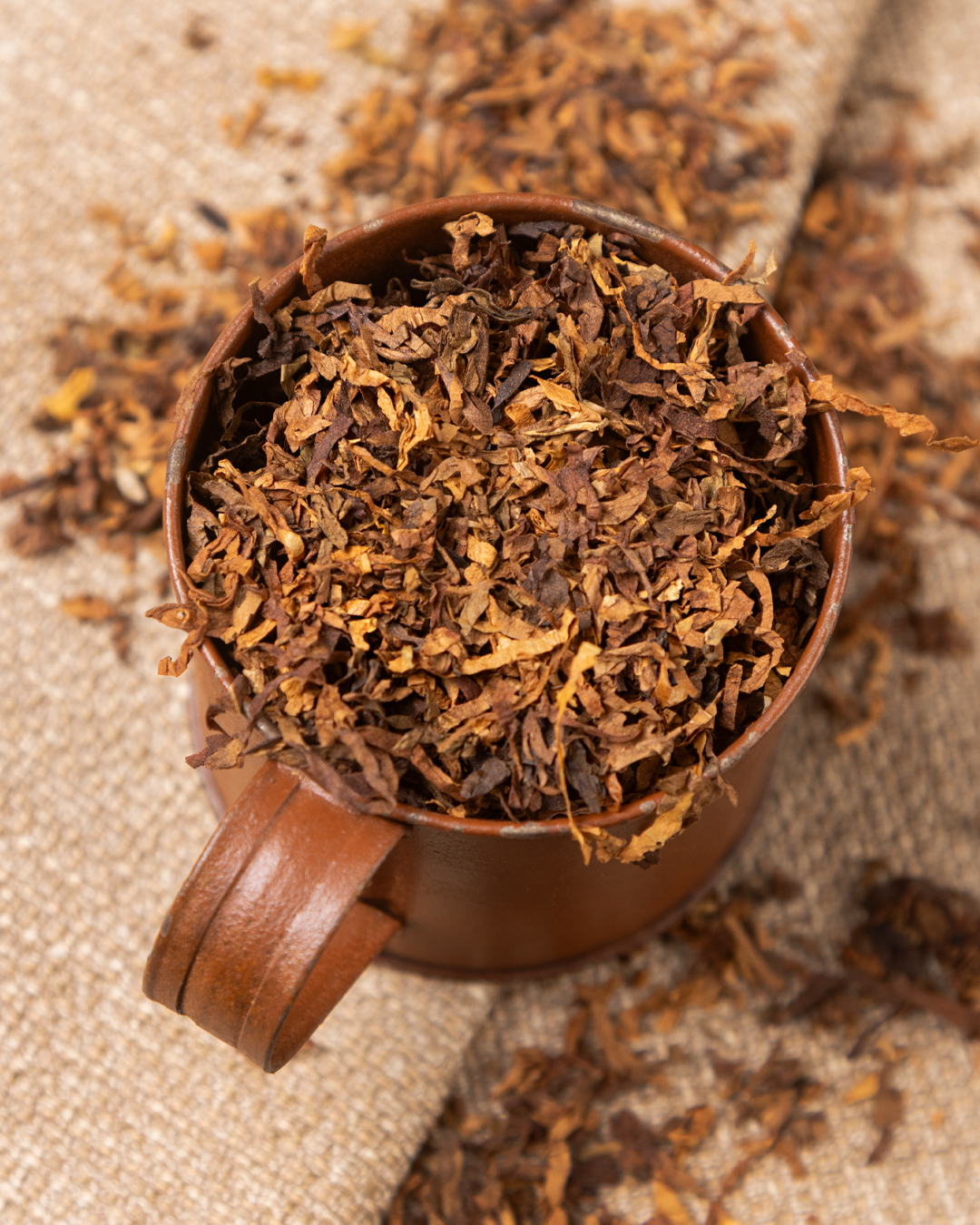
White Burley
[AB]: As far as nicotine content, does Burley tend to be stronger?
[JR]: It's weird. White Burley is nicotine-wise fairly comparable to a Bright or maybe an Orange Virginia, but where Virginia is a little more acidic, Burleys are a little more alkaline. So while the nicotine may be similar, your bioavailability of nicotine is higher — you absorb more of it.
[AW]: The pH thing is interesting because we think about tongue bite a lot. People associate it with the actual blend itself — maybe Aromatics smoking a little hotter because of the casing or topping. But so much of tongue bite does have to do with pH.
[JR]: Yes. Body chemistry and the acidity or alkalinity of the leaf itself can certainly play a role. In a traditional casing, many times you'll see something like vinegar, or some makers use acetic acid — that's to temper the leaf and bring down the pH.
Burley in Blends
[AW]: You've got White Burley and Dark Burley — can you talk about how you'd use each in a blend?
[JR]: I most commonly use Burley as a condimental thing, sometimes in small enough quantities that may not even bear mentioning. A little Dark Burley can be really useful if you're trying to give some shadow to a flavor that's too bright and give a little nicotine push. White Burley works really well to spread flavor out and dilute a little bit. Air-cured leaf in general is very absorbent — it's widely used in Aromatics because it'll just drink up all of your flavoring. But it takes those same characteristics into play with other tobaccos, so it can absorb and diffuse certain flavors, and it really melds into the flavor profile of everything around it.
Using Dark Burley with Bright Virginia gives a really nice contrast. Using Dark Burley with Red Virginia leans into the Virginia flavor but gives it that cigar oomph at the base. If you're working with a predominantly Burley blend, you really have to look at what flavor profile you're working toward — use Bright if you're trying to add sweetness and lightness, or Red if you're trying to lean into the cocoa and molasses aspects.Favorite C&D Burley Blends
[AB]: Any personal favorite Burley blends that C&D makes?
[JR]: I really like Burley Flake #5. It's a neat old-school Burley blend — a touch sweet, with a deep richness and a little spicy quality. Pegasus always comes to mind too. And I actually really like Old Joe Krantz Blue, which is really geared toward the White Burley profile — predominantly White Burley with a little Red Virginia and Bright. It's neat to use a leaf that would normally just sink into the background and use it as a focal point. Crooner does this too, where the cube cut is mostly White Burley, with a little molasses and Deer Tongue added.
[AB]: Probably the one I've smoked the most of is Crooner as a Deertongue lover. But also Night Train — a deep cut in the portfolio that I smoked when I first started working here and loved. And Pee Dee from the Low Country line. When I first smoked it, I messaged Jeremy and called it an elevated codger blend. It's a modern twist on an American classic.
[AW]: The one I reach for the most is probably Redburn. I know there's other stuff in it besides just Burley, but it is a Burley-forward blend. I remember smoking it and thinking it was really good, and then I let it age for a year or two and was like — whoa. The amount of sweetness that's there, despite it being an air-cured-focused blend, is really cool. It ages remarkably well.
[JR]: There's enough natural sugar in the molasses and in the Virginias used that it will still ferment. And the way Burley absorbs flavors around it — Burley itself won't ferment, but it'll come along for the ride.
Eight State Burley
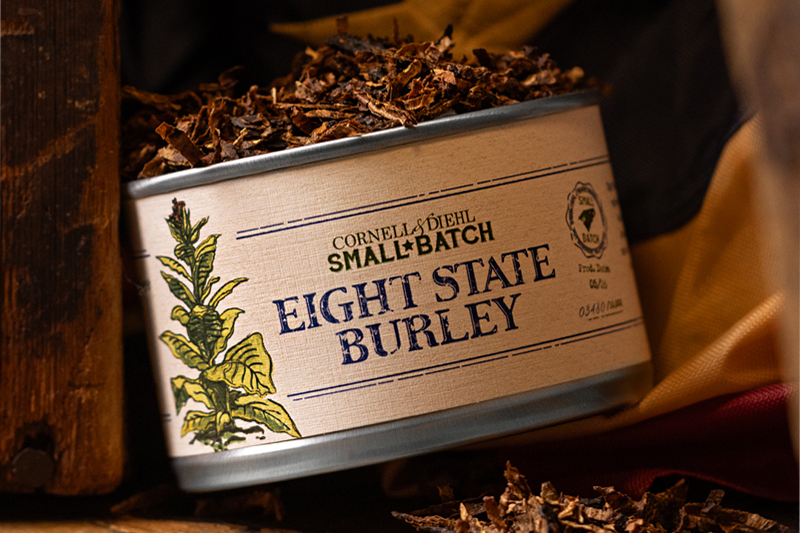
Coming Soon: Eight State Burley
[AW]: We wanted to talk about Burley today because you guys are working on the next Small Batch for this year — a new version of Eight State Burley. For me, Eight State is such an elegant, reliable, everyday smoke. If I'm reaching for something with that nostalgia, where the room note is going to be evocative of my great-grandfather smoking a pipe — that's what you get. But you still get that C&D experience: really tobacco-forward, a lot of care put into the sourcing of the leaf, the components, and the balance. It's a really well-done example of C&D's approach to this historic genre, elevated for the modern smoker.
[JR]: It's also not common to see Burley paired up against Oriental. And not common to see Oriental grades and crops from 2004 and 2005 — so there is a nostalgia just to the tobaccos themselves. When they come together, it's really soft and smooth. Elegant is the right word.
[AW]: One of the things that stood out to me in this year's version is the Guatemalan Dark Burley. Can you talk about that?
[JR]: It has such a nice rounded flavor. It's not complex, but the flavor it brings is absolutely enjoyable on its own. I think it adds just a subtle dark chocolate addition to Eight State Burley.
One thing that's really cool about the interplay between Burley and Oriental: Burley tends to hit the back palate — you don't really get much at the tip or mid tongue. The flavor lives back there. With Oriental, it's almost all in your nasal cavity. Those tobaccos really sing on the nasal palate. And combining those, then adding just a bit of Virginia to bring flavor forward to the tip of your tongue — it works in a neat way. I'm always working to make a blend that is engaging to all of your senses, and all of your palate.[AW]: As much as this conversation is about Burley, it's also really interesting how Orientals can shape different classes of blends entirely — from Steamworks to Palmetto Balkan to Eight State Burley. Each one showcases those aged Orientals in a completely different way.
You may also enjoy:


Comments
Bob Runowski, please. Otherwise a great article about a great varietal.