


 |
|
 |
|


Introduced in 2015, the American Pipe-Making Exposition is an annual Smokingpipes tradition that showcases the work of U.S.-based artisan carvers, the style of each pipe united by a specific theme. Past years have highlighted the use of bamboo, certain finishing techniques, and aesthetic influences, and for 2021 — the 7th edition of the Expo — we return to 2017's theme: accent stems.
Pipe stems have existed for almost as long as pipes themselves have, but mouthpiece styles have evolved considerably over recent decades, especially with the emergence of artisan pipe making. Many artisan carvers devote as much, if not more, time to stem making as they do to drilling and shaping the bowl, hand-cutting and -filing mouthpieces for optimal smoking comfort and performance, and such intimate, hands-on dedication also allows for more intentional and unique styling.
Sixten Ivarsson, widely considered the grandfather of the artisan pipe-making movement, was among the first to consider a pipe's stem as part of the piece's overall composition, rather than as simply an appendage necessary for smoking. While craftsmanship and engineering remained paramount for Sixten, the Danish carver also valued a stem's aesthetic appeal and prioritized how it harmonized with the stummel. In the same way that a painting's beauty could be obscured or promoted by its frame, so too could a stem's compositional balance, or lack thereof, affect a pipe's compositional harmony.
Since the time of Sixten, artisan carvers — especially American makers — have expanded upon this aesthetic incorporation of pipe stems, integrating accenting materials or vivid color palettes for added flair or shaping the stem to match the design cues of the stummel, sometimes in ornate fashion. In the early years of modern artisan pipe making in the U.S., a few carvers traveled to Denmark and visited Danish masters like Jess Chonowitsch and Hans "Former" Nielsen, learning to appreciate Sixten's and other Danes' approach to stem making and expanding on that aesthetic perspective in their own work. This expansion remained founded in Sixten's idea that a stem is part of a pipe's overall composition, but these American artisans began contributing their own creative styles to that maxim, experimenting with new materials, innovative engineering, and vibrant colors beyond what Sixten and others had achieved previously.
With the influence of mentorship in American pipe making and the ease of sharing ideas across social media, the evocative stem styles of those early carvers have permeated a number of portfolios across the U.S., and many American pipe makers fashion split stems and utilize unique materials, like Bakelite or colorful vulcanite for their mouthpieces, or render standard, black vulcanite in eye-catching ways to best fit with a specific pipe. This year's Exposition celebrates that ingenuity and creativity with an array of 16 pipes.
Thank you to all the carvers who participated in the 7th Annual American Pipe-Making Exposition. Be sure to visit the Exposition's page to see detailed photographs and descriptions of each individual pipe.
Visit The American Pipe-Making ExpositionNote: The following transcription has been edited for clarity and brevity.
Abe Herbaugh:
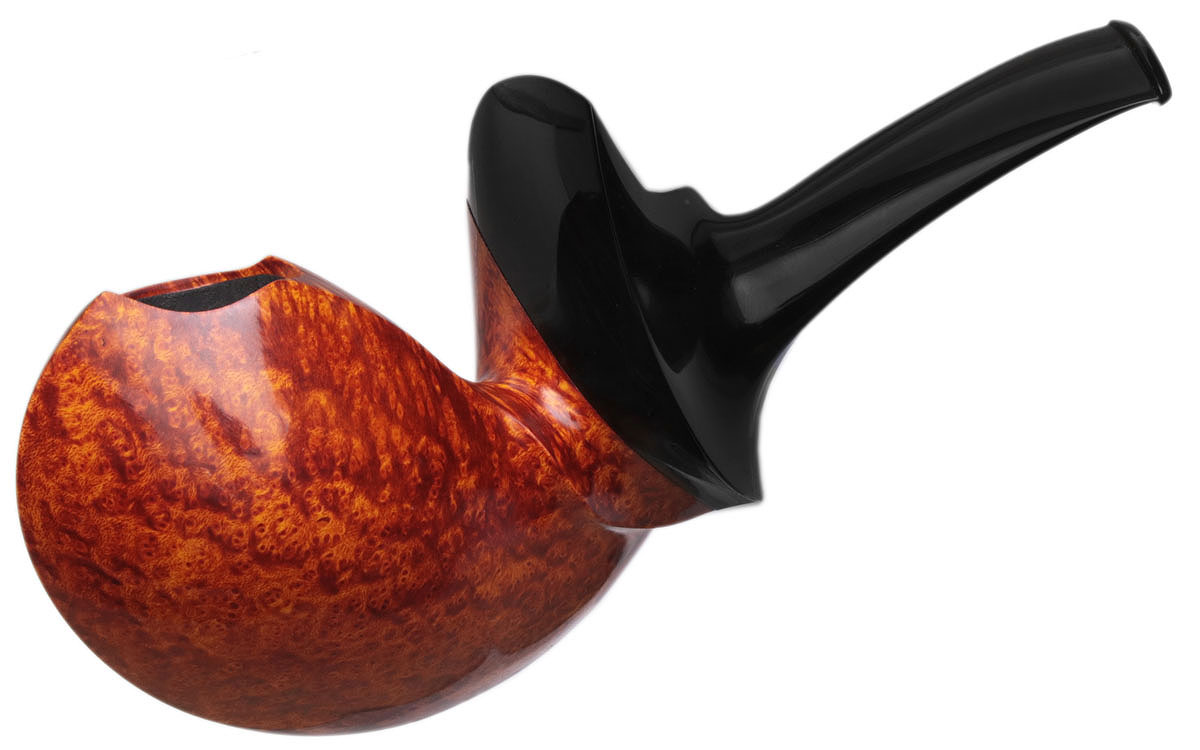
Abe Herbaugh: Smooth Fighting Fish
[Truett Smith]: A couple of months ago, Abe Herbaugh accidentally injured his hand, and so he's been out of commission while recovering from that. The pipe he submitted for this year's Expo was actually the first pipe that he's made since his injury, so we're really thankful and honored that Abe was able to participate in this year's Exposition. And, of course, we're glad that he's back making pipes, especially. For his submission this year, he's sent us a stunning Blowfish rendition. Rather than using alternative materials for his accent stem, he's instead focused on the shape and really stylized the stem base to echo the different ridge lines and facets of the bowl shape itself. The lines of the bowl extend into this more stylized stem to great effect — in silhouette, it creates a neat optical illusion and introduces ambiguity as to where exactly the stem begins and where it merges with the stummel. It's a really cool design, and really impressive work overall. As a pipe itself, it's beautiful — the grain is stunning — and it fits in perfectly with this year's theme.
Bill Shalosky:
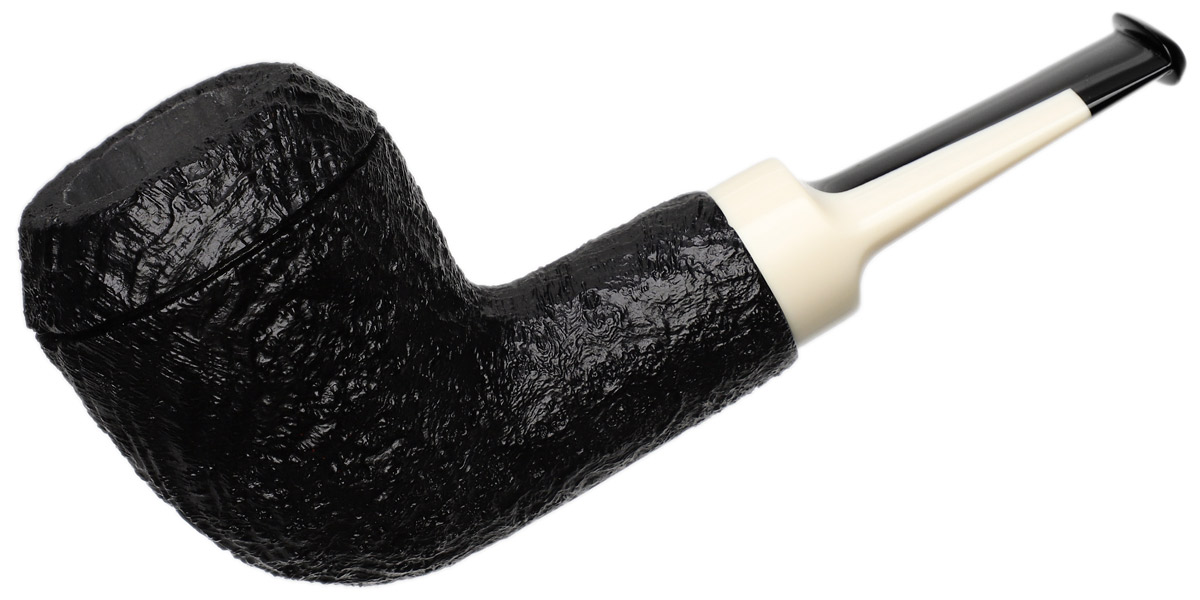
Bill Shalosky: Sandblasted Rhodesian with Juma and Fordite
[Andy Wike]: For his entry into the Expo this year, Bill Shalosky has presented us with a really interesting take on the Rhodesian. It's very iconically Shalosky in form: It's very tall, very muscular, very industrial with high-set beadlines. For the accent stem, Bill's actually riffed on a sort of iconically American theme here, which is the split stem. Split stems are made by inlaying one material inside another, and then when you cut it down — typically into a saddle — you actually get this really interesting juxtaposition of materials. In this case, Bill has inlaid ebonite into pale white Jooma, and that's created this really interesting, retro, black-and-white effect. What's more interesting, though, is that Bill's actually elongated the wings of this saddle stem to extend almost all the way to the bit.
Typically with a saddle stem, you'd see something like this executed as more of a short throw, with the wings covering only a little bit of the stem. They typically don't reach all the way to the bit, but here Bill's really elongated those wings, which in turn makes the profile more dramatic, especially with this juxtaposing color palette. It really plays nicely with the rest of the composition here. Also, as sort of a hidden Easter egg, Bill's also incorporated a bit of his signature Fordite as a hidden accent along the base of the stem near the tenon. All in all, it's just a really awesome pipe from Bill, and we're super excited about this one.
David Huber:
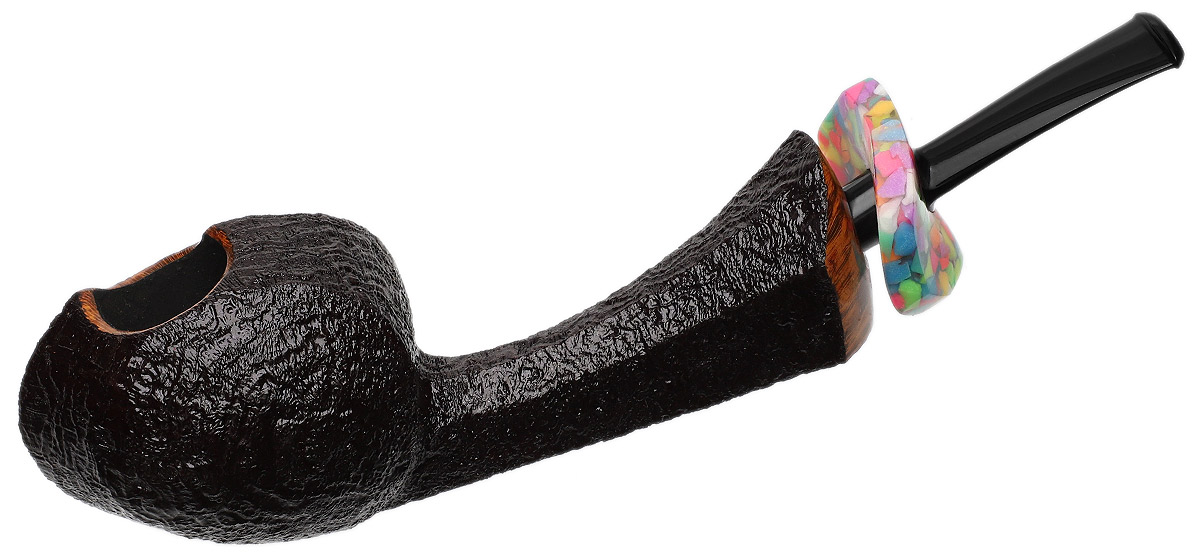
David Huber: Sandblasted Glowfish
[Shane Ireland]: David Huber is one of those American artisans whose work really encapsulates the melting pot of influences you'll find in pipe making. Throughout his portfolio, he pulls from Russian, Japanese, and Danish masters, as well as his American contemporaries — fusing all of those influences into something that is unique and constantly pushing the envelope. Over the past several years, David has caught the attention of pipe smokers all over the world by taking risks — typically in the form of aggressive steps towards design elements and functionality that feel fresh and dramatic. So it's appropriate, then, that for his entry into the Expo this year, David submitted a very Japanese-style Fugu Blowfish.
When looking at the design, what immediately captures your attention — aside from the really lovely lines, excellent paneling, and a crisp, very Huber sandblast — is the big splash of color at the shank end. David sourced the material, a type of polymer resin, for this accent from a gentleman who makes it in small batches by hand; it has this technicolored, confetti look to it, but more importantly, it glows in the dark. So, rather appropriately, David has dubbed this pipe the Glowfish, and it does, indeed, glow in the dark. The shape itself has these Tokutomi-esque lines and curves, like ripples in the water behind this creature moving forward, and the accent emulates that with a bright, contrasting ripple with all of these colors, which works incredibly well against the darker sandblast. There's also a stabilizing ring around the military mount that's crafted from the same material. All in all, it's a really innovative, lovely entry from one of the more daring pipe makers of our time.
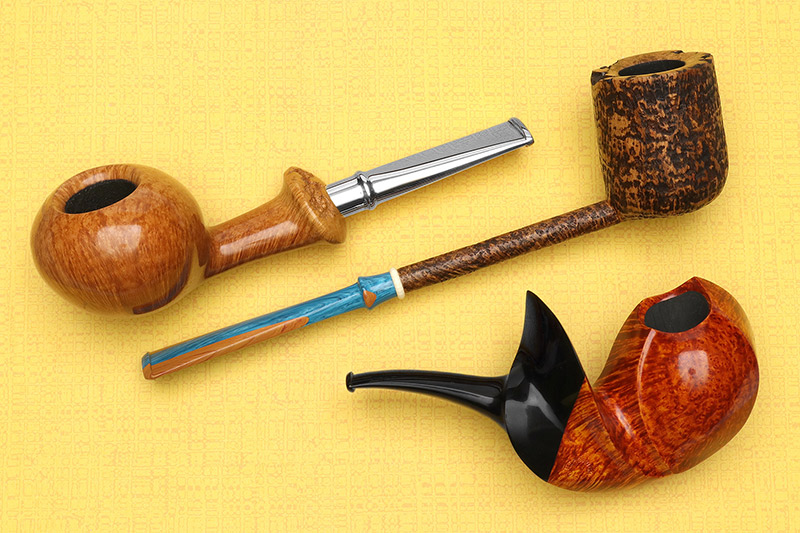
Pipes from Adam Davidson (top), Scottie Piersel (middle), and Abe Herbaugh (bottom)
Scottie Piersel:
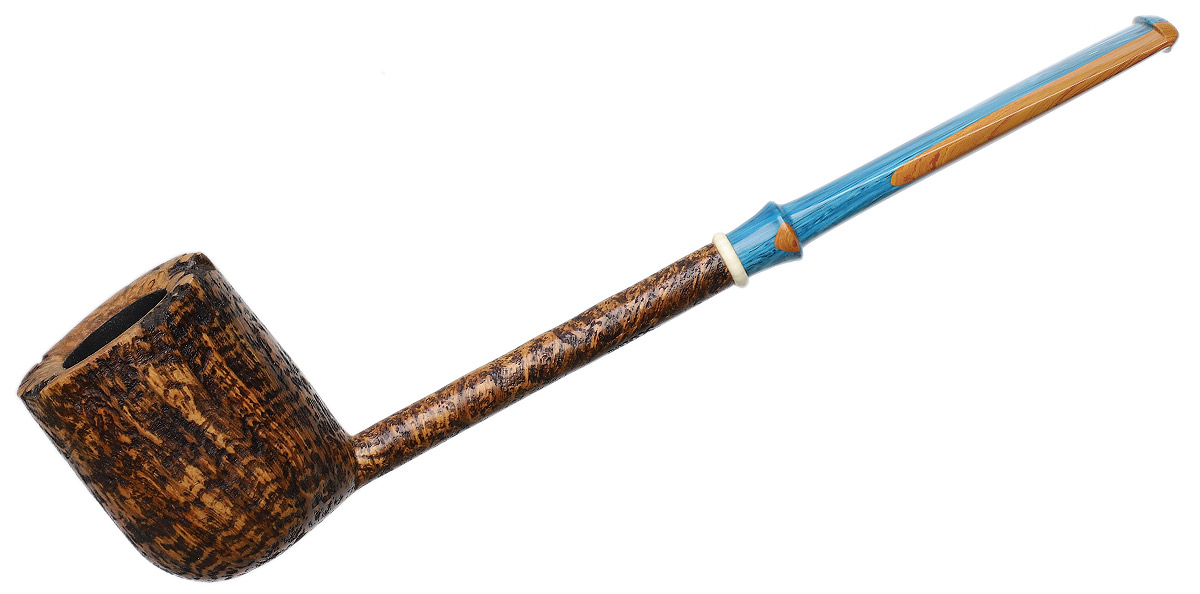
Scottie Piersel: Relief Contrast Pencil Shank Billiard with Juma and Ivorite
[Truett]: For her entry into the Expo this year, Scottie Piersel crafted one of her signature, pencil-shanked Billiards. Though incredibly sleek and trim compared to the bowl, it's quite sturdy; it's lined with stainless steel, with a reverse tenon, and is super durable. For the stem, though, Scottie fashioned a split stem from this really striking, cerulean blue-colored Juma, which normally is a white, creamy color. The outside of the stem is a proprietary cumberland that Lee von Erck, another American pipe maker, uses. Scottie combined the two materials for the stem, and the color of the cumberland matches well with the finish, which is another signature of Scottie's. She's presented this pipe in her iconic contrast relief finish, which combines smooth and sandblasted textures and two different stains for a really unique, dual-textured motif. Excellent work, Scottie.
Clark Layton:
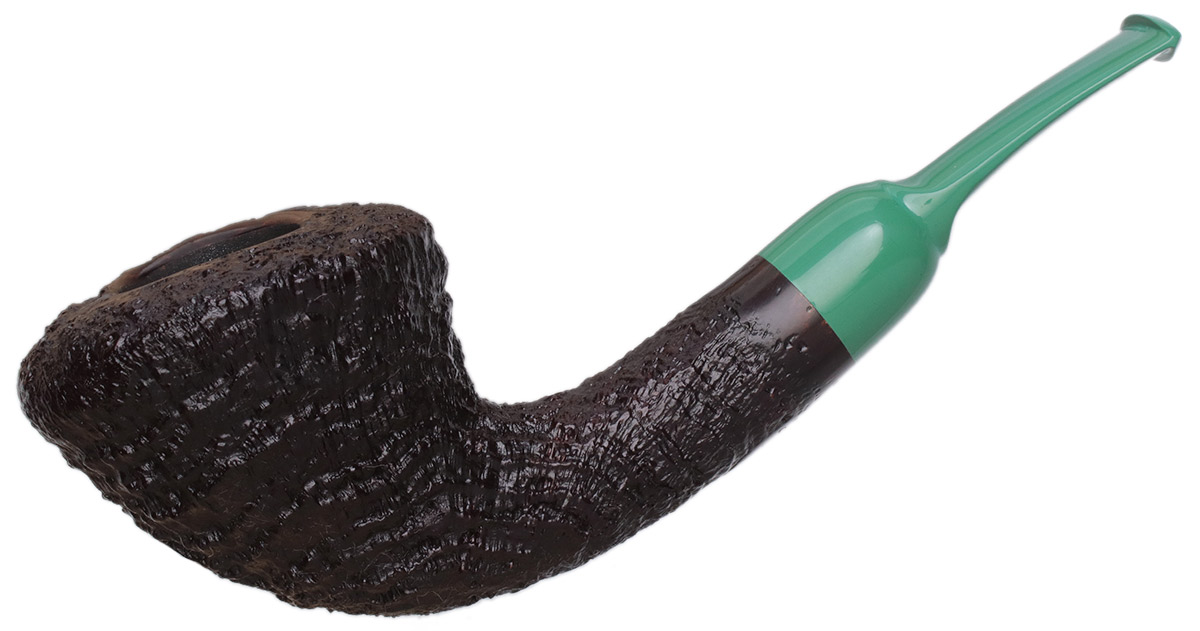
Clark Layton: Sandblasted Bent Dublin
[Andy]: For his entry into the American Expo this year, Clark Layton sent us this really great Freehand bent Dublin. The shape itself is quite organic and fluid. It has this sort of mushroom-like rim that's slightly domed. The sandblast finish is excellent as well; it's very evocative of Clark Layton's style with a deep, gnarly texture and loads of high-relief growth rings. The grain orientation is really great, too, with those rippling rings all sort of emanating from the heel. And for his accent stem, Clark's used a gorgeous piece of solid-green vulcanite. The shade and color are stunning — sort of like a dark sea foam green. And it contrasts nicely with the warmer hues of the dark sandblasted stummel. Compositionally, it creates a neat juxtaposition of warm and cool tones that just works really well.
Ryan Alden:
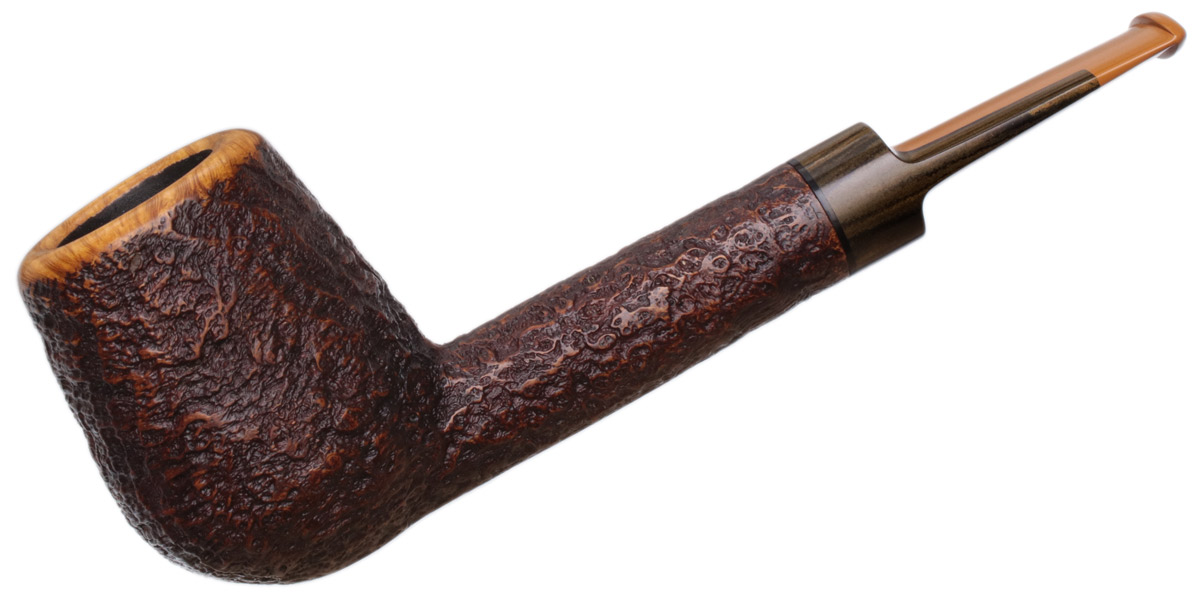
Ryan Alden: Sandblasted Lovat
[Truett]: Ryan Alden fashioned an excellent Lovat for this year's Expo. It features a split stem of brindled vulcanite and solid, butterscotch-colored vulcanite, which matches the lighter hues of the brindled rod nicely. Ryan's also finished the pipe to match the stem for this really cohesive, consistent aesthetic and composition. While the stummel is sandblasted in Alden's signature style, Ryan's left the rim smooth and polished with a stain that echoes the butterscotch hues of the stem. Ryan's really good at executing modern classic pipe-chart standards like this, especially in sandblasted finishes, so his contribution to the Expo this year fits in well with his style; but he's taken it that extra step, given it that extra flair and flash with the split stem, making for a great addition to this year's Expo.
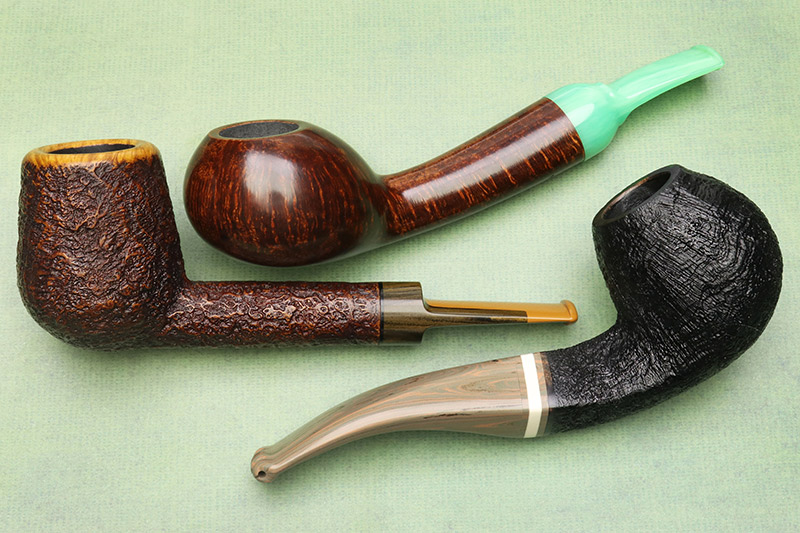
Pipes from Ryan Alden (top), Micah Redmond (middle), and Silver Gray (bottom)
Todd Johnson:
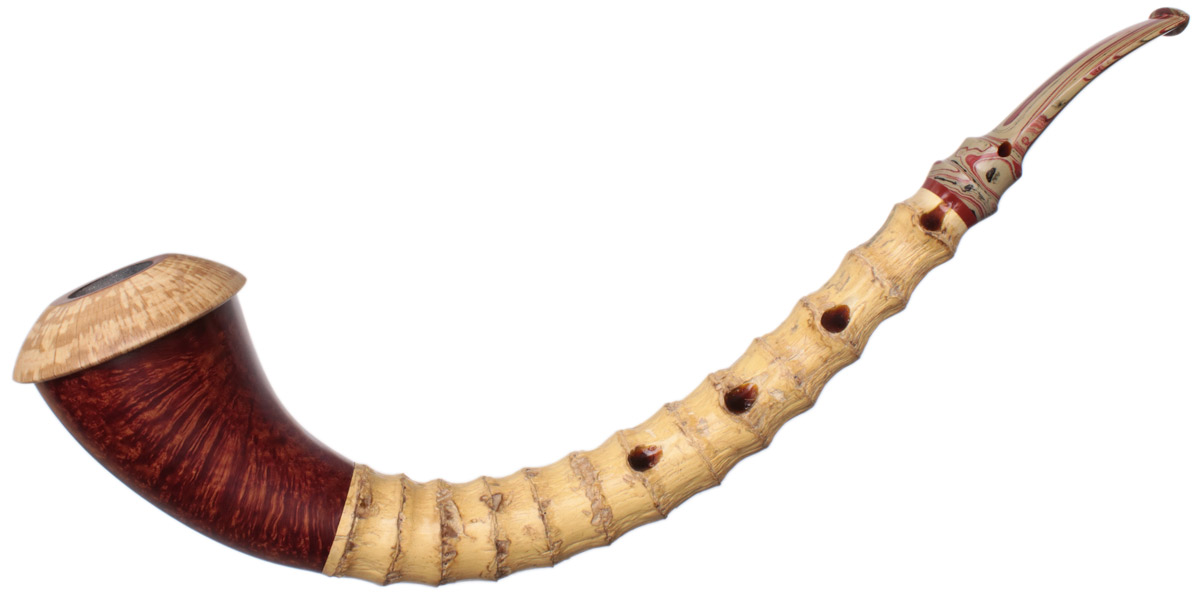
Todd Johnson: Smooth Calabash Churchwarden with Bamboo and Beechwood
[Shane]: Todd Johnson is among the godfathers of modern American pipe making, and he's definitely not shy when it comes to flexing his creative muscles. Nor is he a stranger to innovating in terms of both design and composition, and also techniques. In fact, many of the techniques used by modern pipe makers have been either pioneered by Todd or refined by Todd. He's had a hand in training a lot of people, and this piece is a really good example of how Todd continues to push the boundaries farther than any of us have seen before. It's a breathtaking piece.
Perhaps the first thing that catches your eye about this piece is the bamboo — a long, curling, flaring section that's incorporated beautifully into the overall piece. I would never have thought that a Calabash-style bowl would have gone so well with something so highly organic, dynamic and asymmetrical. Arguably, every individual component of this pipe could be the main feature. The beechwood cap is flawlessly grained and expertly applied to match the grain of the bowl itself, which too is amazing. The bamboo, likewise, is just stunning. And then there's the stem. In many ways, Todd's made the stem an extension of the pipe's main themes. The pipe is stained this sort of oxblood color stain in the pipe, and the pale and light tan shades found in both the beechwood cap and the bamboo offer a lovely contrast. And, so, Todd has chosen to echo that whole palette with a sort of sand- and oxblood-colored, brindled vulcanite mouthpiece. He's also used nodes of epoxy along the bamboo to match that deep red color, and he's continued the flow of the bamboo's knuckles through the stem.
Todd's entry this year demonstrates the application of a very different color palette as an accent stem, but also a carving technique that supersedes what we typically see with saddle or tapered stems. It's just a striking piece overall and another one of my personal favorites from this year's entries.
Scott Thile:
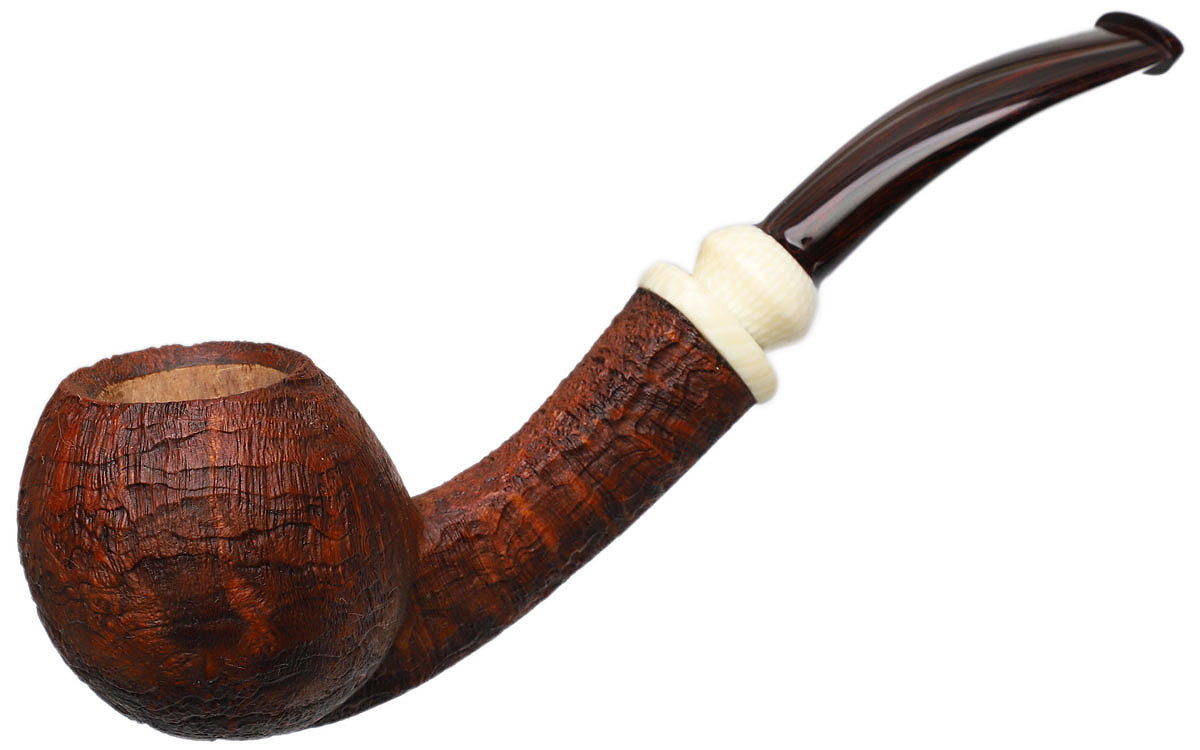
Scott Thile: Sandblasted Bent Apple with Ivorite
[Andy]: Scott Thile's entry into the American Expo this year is a great piece. It's iconically Thile in design — sort of a Freehand bent Apple shape with plump cheeks and a softly paneled, upward curving shank. What's really interesting here is the accent stem: Scott's taken a modern approach to a very traditional accent stem material, Cumberland. Cumberland has been used by various makers and marques for decades, and it sort of has this distinctive, wood grain pattern to it. In this piece, Scott used that pattern and visual texture to echo the beautiful contrast sandblast of the stummel itself, but he's also buffered those two very similar palettes and patterns with double accents of Ivorite. The end of the shank is adorned with a softly squared off Ivorite band, following the lines and form of the shank itself, and that continues into a more domed, traditional Ivorite accent on the stem itself. Those two accents really tie the piece together and elevate the composition further. Great work from Scott.
Alexander Hasty:
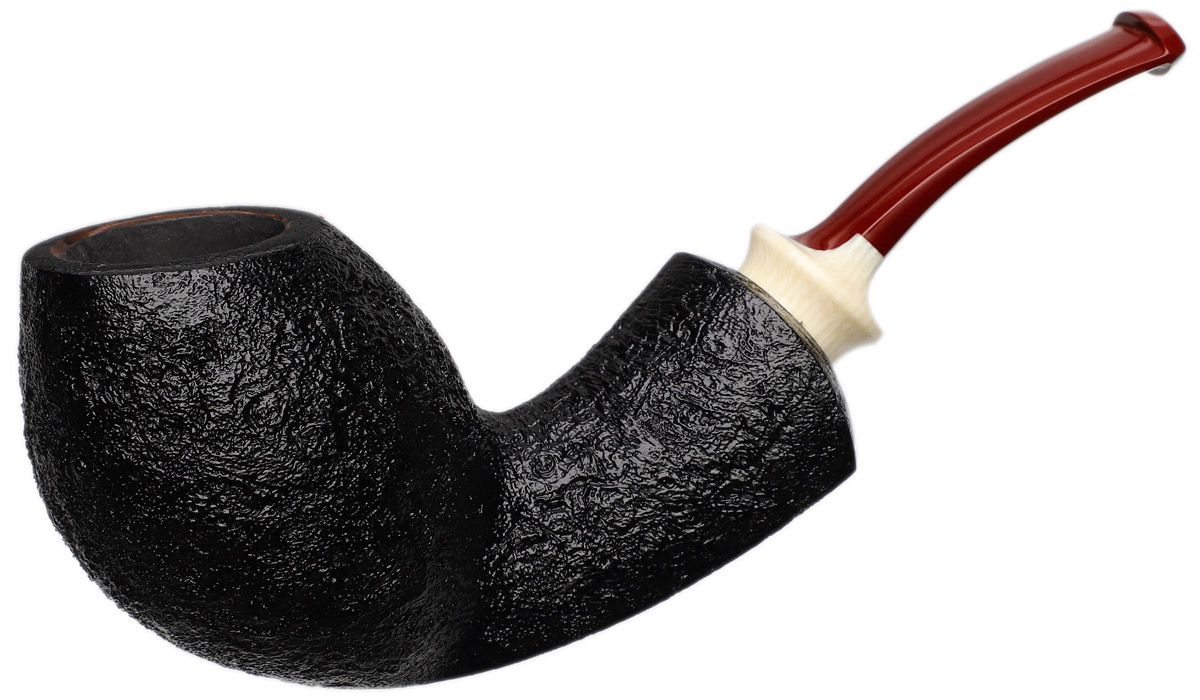
Alexander Hasty: Sandblasted Bent Egg with Ivorite
[Truett]: Alexander Hasty made this bent Egg for this year's Exposition, and it fits in nicely with his general American-Danish style — complete with really soft lines, a supple bowl, and a teardrop shank. For the stem, he's made a split stem out of Ivorite and this deep burgundy-colored vulcanite. Alexander is a fan of dark sandblasts and darker finishes, and he enjoys contrasting them with accents or stems. So this composition fits in well with his style and the exposition's overall theme. The colors of the stem pair well with this black sandblast. There's a bit of flash from the Ivorite, married then to the crimson vulcanite, and it almost gives it kind of a dress pipe look but with some extra color. It's really eye-catching, but still quite classy and elegant. And it's just a great piece overall.
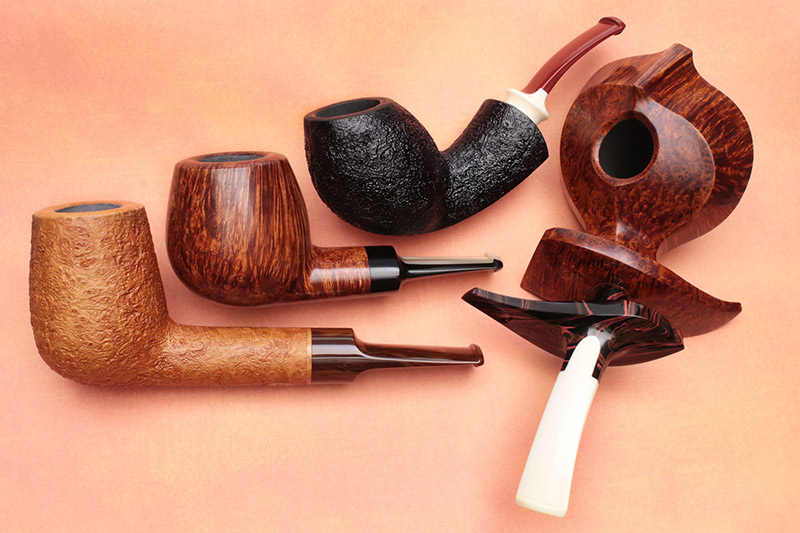
Pipes from Alexander Hasty (top left), Alex Florov (far right), Jared Coles (middle left), and Sam Adebayo (bottom left)
Alex Florov:
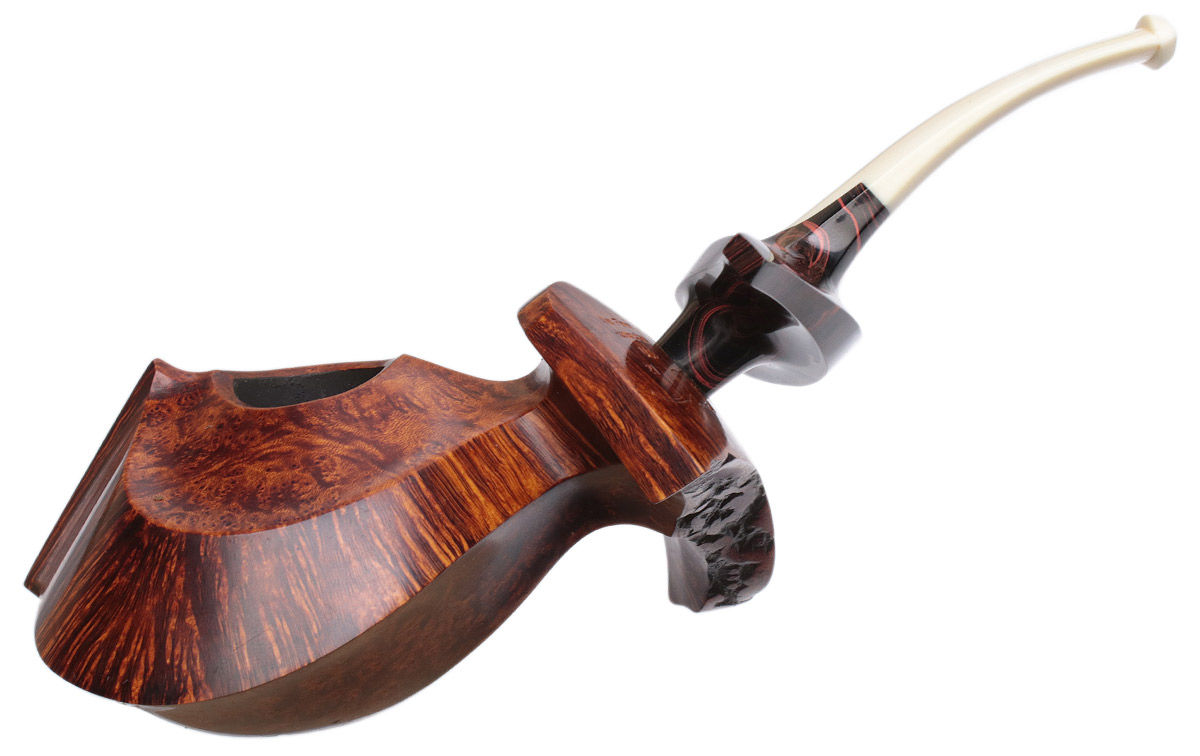
Alex Florov: Smooth Autumn Leaf with Juma
[Shane]: Russian-American pipe maker Alex Florov is no stranger to sculptural forms; in fact, Alex's body of work has largely been influenced and informed by some of the great Japanese masters, like Kei Gotoh and Hiroyuki Tokutomi. Those influences come into play here, especially in the shaping. The pipe itself follows this really dynamic, wild, and organic form with excellent use of the natural grain patterns in the wood. For the accent stem, Alex complemented the contrast stained bowl with the wood grain pattern of brindled vulcanite, and he has also incorporated a split stem — another nod to the American tradition of playing with accents, specifically Juma. In this case, Alex has used white Juma to create a buffer of sorts between the complementary colors and tones of the contrast finish and the traditional cumberland. But, of course, Alex didn't stop at simply playing with the color palette; he also creatively echoed the shaping of the shank through the stem itself. There are these lines that sort of run in opposite directions, but Alex has interwoven them with excellent balance and harmony, emulating this sort of rippling effect that suggests motion, as if the form is moving through space or water. So overall, Alex's contribution is an excellent piece, combining several different themes to great effect.
Sam Adebayo:
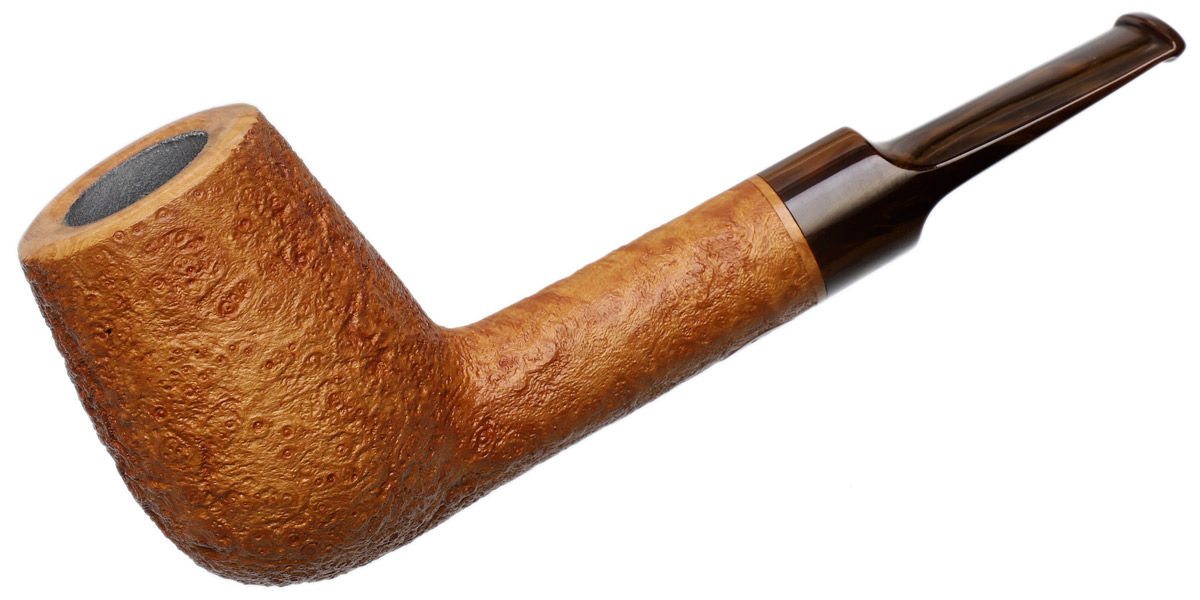
Sam Adebayo: Sandblasted Billiard with Bakelite
[Andy]: Sam Adebayo's entry into the American Expo this year is a large, traditional take on the straight Billiard. It's reminiscent of the old Dunhill LB with a saddle stem, but there's also some Danish elements here as well. There's a noticeable swell to the cheeks along the bottom of the bowl, and the rim is smooth and slightly domed; there's also a good bit of sweeping gesture to the transition, but the accent stem is really interesting, too. It's something that Sam's played with a lot over the years, but also something that's really become iconically American, and that's the use of vintage Bakelite as an accent stem or as an accenting material. The Bakelite that Sam's chosen for this piece is really compelling, I think. It's this melange of dark mocha and lighter brown tones. It's sort of monochromatic, but it really works against the sort of lighter shade of the stummel itself. Really concise sandblast on this, and just a gorgeous pipe overall. I really like the color palette of this one.
Jared Coles:
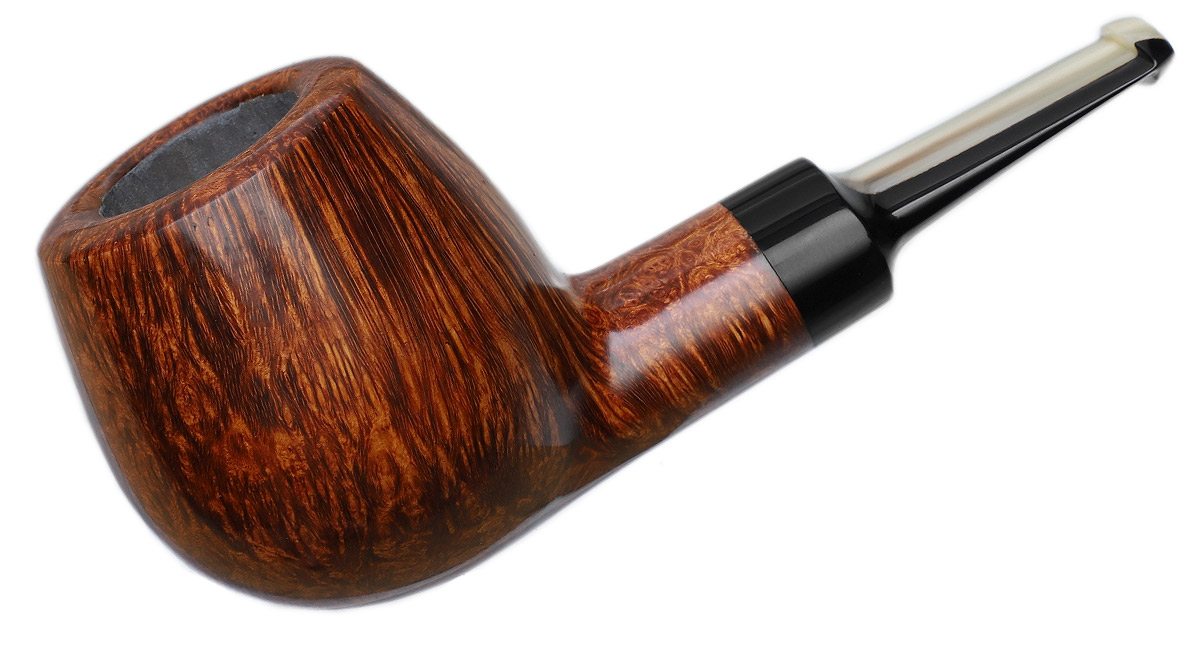
Jared Coles: Smooth Apple with Horn
[Shane]: Jared Coles is one of the first American pipe makers that come to mind when I'm thinking about how this school of pipe making effortlessly transitions back and forth between the innovative and the traditional. If you've been following his last few American Expo submissions, you already know that Jared is no stranger to taking on more ambitious projects and challenges. I really love the understated nature of this year's submission, at first glance. The proportions here are definitely on the neoclassical side, and the piece is both adorably chubby and really powerful and muscular. Jared found a great balance here: a handy pipe of pocket-sized proportions, elevated with a touch that is uniquely American.
For his accent stem, Jared has gone the split stem route, which is another nod to sort of the culture and heritage of American innovation in pipe making. In profile, it looks like an unassuming Vulcanite stem, but from the top view you can see that within the black vulcanite, he has inlaid traditional horn — bovine horn, most likely. And I really love that for a number of reasons. One, the contrast between those two materials is great. Two, they're both very traditional pipe making materials, and here they're employed in a very different way. Horn was very popular as a stem material many decades ago, and it's still very popular as an accent material. One thing about this that's really interesting and really ambitious about this particular piece, however, aside from it being a split stem, is that Jared took the wings of the split stem all the way up through the entire mouthpiece. That extension creates this really stark, dramatic contrast. I also love that you have this subtle touch of this organic material, and the color variation and pattern of horn is always so beautiful. There's also a neat little inlay on the rim of the pipe that echoes that theme with a dot of horn surrounded by a circle of vulcanite. It echoes the chubby, playful nature of the pipe and drives home the composition. Really great piece overall and a gorgeous horn split stem.
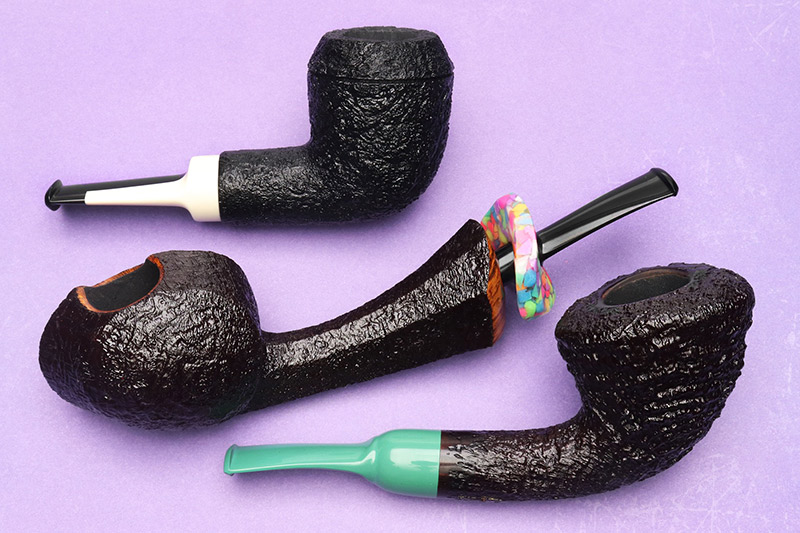
Pipes from Bill Shalosky (top left), David Huber (middle), and Clark Layton (bottom right)
Silver Gray:
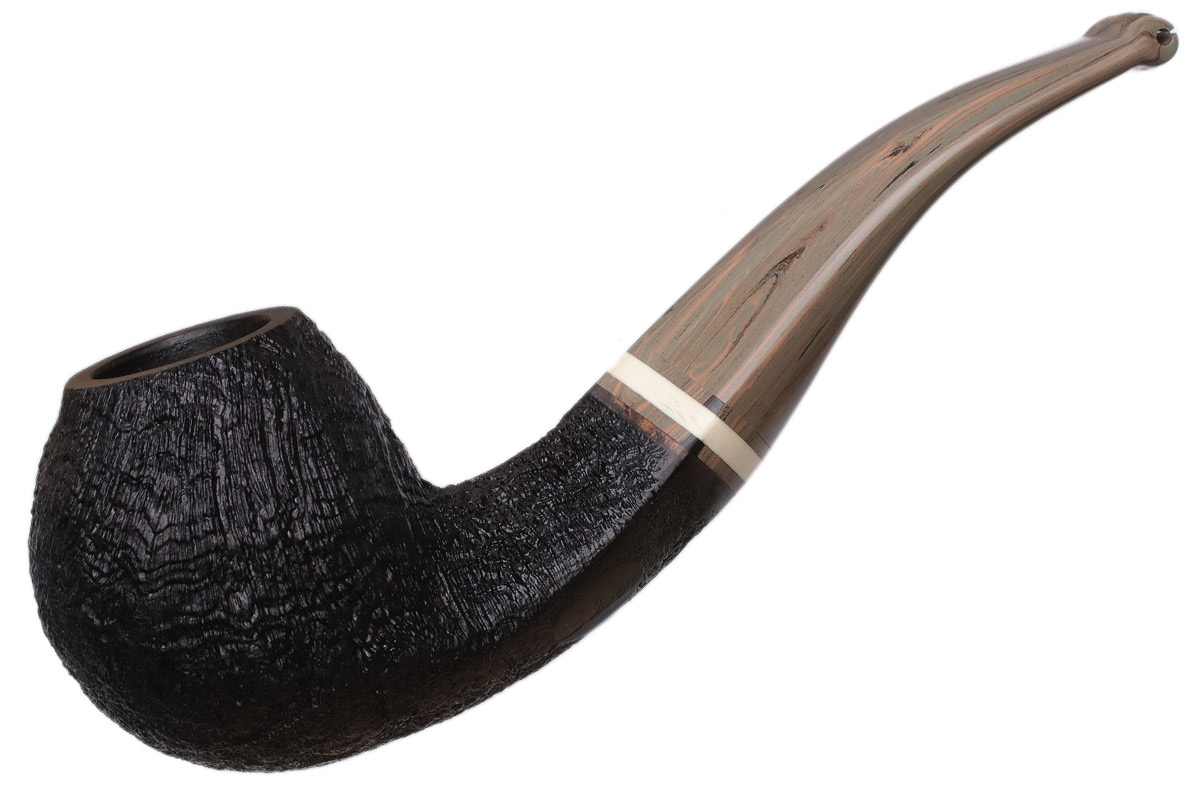
Silver Gray: Sandblasted Eskimo Egg with Mammoth and NAP Stem
[Andy]: For her submission to the Expo this year, Silver Gray presented us with her homage to a somewhat obscure part of Peterson's history: the NAP stem. Charles Peterson secured a patent for the brand's iconic P-Lip design in 1898, but what few people know is that six years later, he actually filed for another patent for a different bit design called the NAP stem, which has this curious clamshell shape. Silver first recreated this historic Peterson stem style back in 2019 as part of an experiment to see how it would perform against modern P-Lips and fishtail bits. For her testing group, she worked with a bunch of different folks in the industry, including Pete experts Mark Irwin and Gary Malmberg, and the results were actually really surprising.
While the P-Lip stem is designed to funnel smoke up towards the roof of the mouth, and the fishtail stem directs smoke directly to the front of the tongue, the NAP stem, or clamshell as she calls it, actually distributes that smoke far more evenly than either of the two. The smoke radiates out from a central funnel in slots spaced 36 degrees apart, resulting in a nice, even distribution of smoke and flavor across the palate.
The pipe itself is a variation on Silver's signature Eskimo Egg shape, in this case combining a more structured, paneled shank with a very robust, Apple-like bowl. For her recreation of the NAP stem, she's chosen this really cool piece of brindled vulcanite. It's sort of this melange of sage green, rust, and dark brown hues with a really interesting pattern. She's also included pale white mammoth as an additional accent, adding a nice bit of contrast. Not only has Silver given us a stem that accents the composition in terms of color palette, but she's also presented us with a stem that serves as a mechanical accent; it actually changes the way that the pipe smokes. I'm really excited about this one.
Micah Redmond:
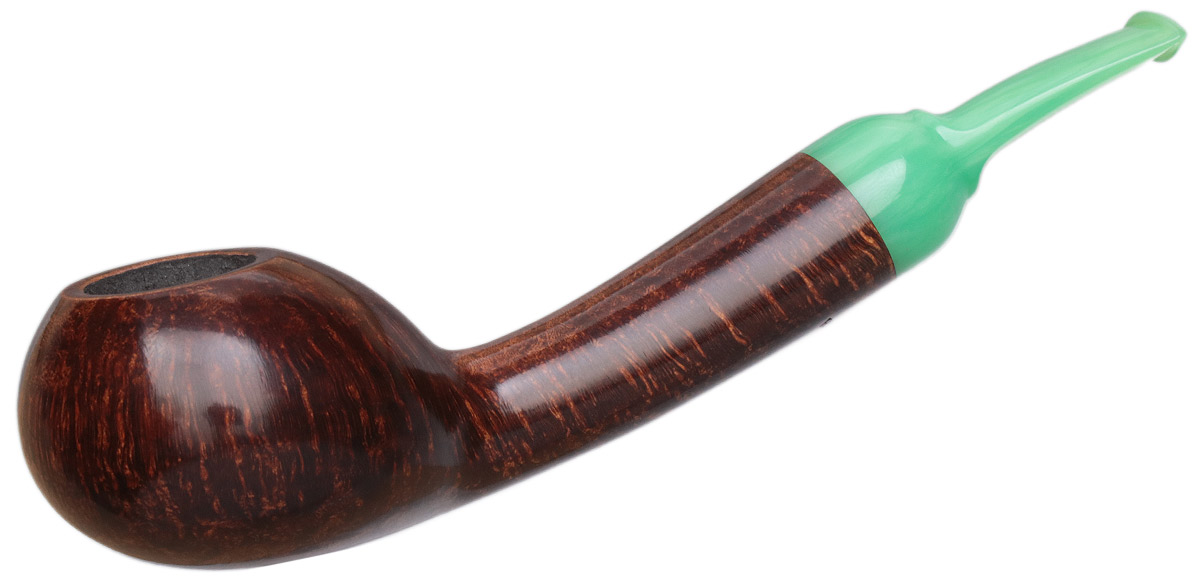
Micah Redmond: Smooth Tomato with Bakelite
[Truett]: Micah Redmond is among the artists and carvers at BriarWorks, and like his colleagues Pete Prevost, Bill Shalosky, and Sam Adebayo, he's an incredibly talented artisan and carver in his own right. For his entry into the American Expo this year, Micah sent us a variation of his signature Tomato shapes. If you're at all familiar with Micah's work, you know that he makes a lot of Tomatoes in a very distinct style; they're really smooth and curvaceous, often with touches of asymmetry or squat proportions, and occasionally presented in long-shanked or hyper-compact versions. This particular rendition is one of those long-shanked ones. It features a squat bowl, but one that's quite forward-urging in profile, and he's paired it to a really evocative, lime-green Bakelite stem that pops against the dark mahogany stain of the stummel. But what's really cool about this piece, apart from the stem and proportions, is that Micah's added some asymmetry in the shank, slightly tilting the axis to correspond with how he shaped the bowl with subtle asymmetry to follow the grain. It's a really cool shape by Micah with an awesome Bakelite stem.
Pete Prevost:
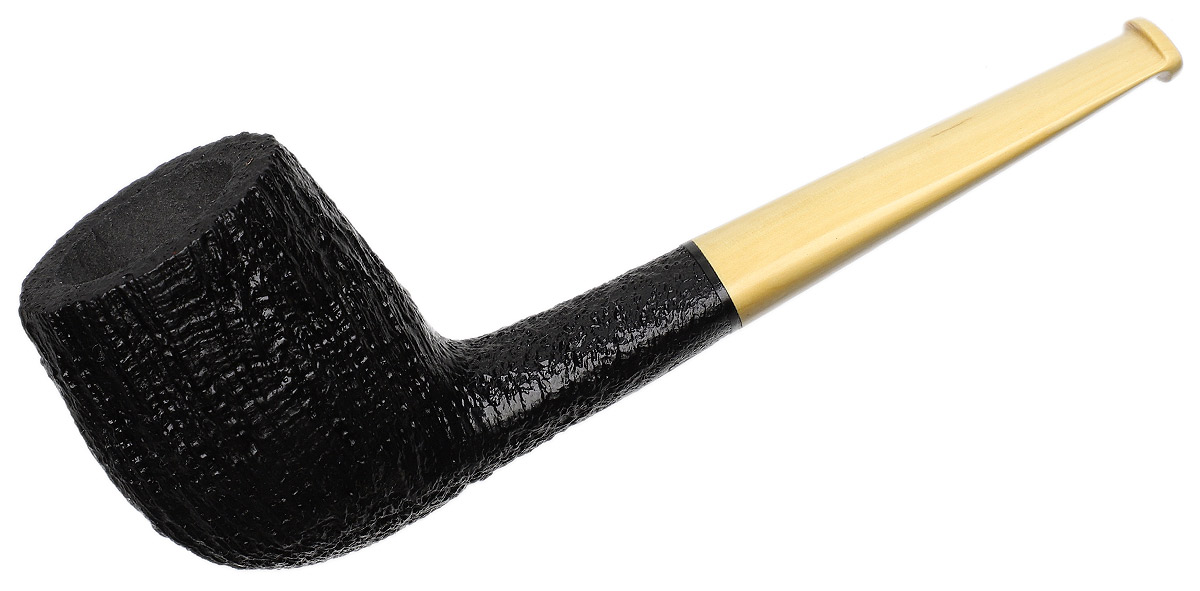
Pete Prevost: Sandblasted Pot with Boxwood Stem
[Shane]: Pete Prevost is another of those American pipe makers who seem to carefully tread the line between homages to classic pipe shapes and really striking, modern compositions. A couple years ago for our alternate materials exposition, for example, Pete made a sweeping Horn shape out of a piece of horn with a horn stem and full Calabash functionality — crazy, crazy stuff. I was really struck by his submission for this year's exposition, because it is so minimalist. It's a sleek, modern, and fast-looking take on a classic shape with a pinched, oval shank, a crisp, detailed sandblast, and spot-on proportions. But the stark contrast between the black sandblasted bowl and the boxwood stem is what makes this piece really special and striking.
Boxwood as a material has been used as a pipe accent for many years — prized for its pale, light coloring and subtle graining. It's a gorgeous wood. And even though we've seen it used as an accent many times, and even though making stems completely out of briar is traditional and old-school, I have never seen a stem made completely from boxwood. It's a compelling choice, and a perfect nod to several parts of the complete global pipe-making history. The piece of boxwood Pete has chosen is gorgeous, as well, and it looks incredible in this configuration.
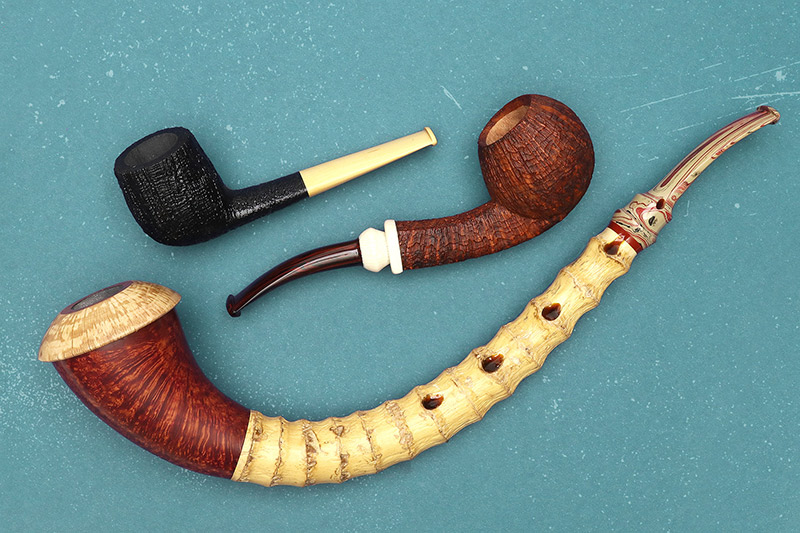
Pipes from Pete Prevost (top left), Scott Thile (middle right), and Todd Johnson (bottom)
Adam Davidson:
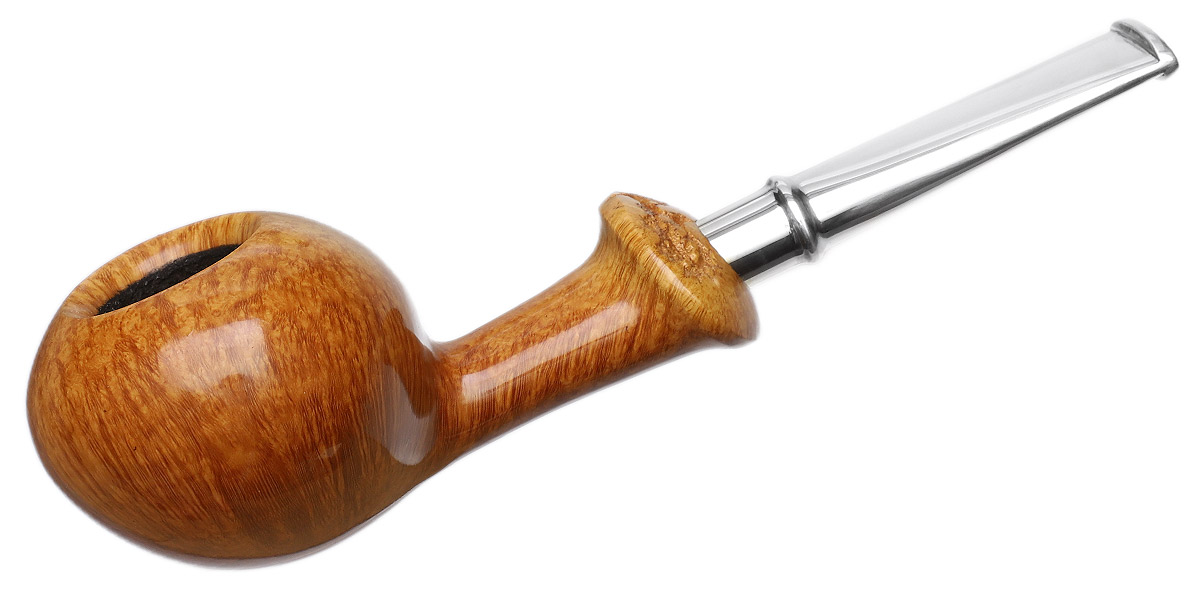
Adam Davidson: Smooth Tomato with Sterling Silver Stem
[Truett]: Adam Davidson has done a number of crazy things throughout the past years' expositions, and he continues that trend with this year's. Just right off the bat, there's no way around it: He made the stem of this pipe from sterling silver. It's reinforced with resin and stainless steel on the inside, but it's fashioned from sterling silver. It's among Adam's favorite accent materials — you see it often adorning his signature Lorraine shape and several other signatures as well. I feel a little lost for words, honestly, because it's just crazy to make a stem out of any metal, really. But to make a stem out of something as precious and cool and amazing as sterling silver, it just blows me away.
However, I'd be remiss not to talk about how excellent the rest of the pipe is. The shape is an inspired take on a Tokutomi/Micke style of Acorn, complete with creative asymmetry along the bowl and shank end; there's also some clever use of plateau. And the grain of this particular block is just stunning. Adam hasn't even stained it; he just waxed it. The natural beauty of this particular block, combined with Adam's artful, precise shaping, is enough to make this pipe worth everything. But pair that with the sterling silver stem, and this is simply a superlative piece from Adam — a fine piece of craftsmanship and art in and of itself.
A special thanks to all the pipe makers who participated this year and who continue to support us and to drive the craft of pipe making forward. We really appreciate you guys. And to all our viewers and customers, we hope that you've enjoyed this year's Expo and have been able to see some of the more interesting things that American pipe makers are doing with accent stems and how designs like these work to propel the hobby and craft forward.
Tagged in: Abe Herbaugh Adam Davidson Alexander Hasty Alex Florov Bill Shalosky Clark Layton David Huber Jared Coles Micah Redmond Pete Prevost Ryan Alden Sam Adebayo Scottie Piersel Scott Thile Silver Gray Todd Johnson
You may also enjoy:




Comments