


 |
|
 |
|


The Art of the Sandblast: Inside the 2026 Global Pipe-Making Exposition


Filmed & Edited by Nicole Weed
Explore the entire 2026 Global Pipe-Making Exposition: The Art of the Sandblast collection on-site now.
Note: The following has been edited for clarity and brevity.
Every year, the Global Pipe-Making Exposition gives artisan carvers around the world a single unifying theme and asks each to submit a piece built around it. This year's theme is the art of sandblasting, a subject the Exposition has not revisited since 2016. In the decade since, the Exposition has grown well beyond its original scope, expanding from an American showcase into a truly global one, and this year's participants were encouraged to approach sandblasting with a broader lens than usual: as a treatment for briar, as a technique applied to unconventional materials, or as a jumping-off point for new methods altogether. Our thanks to every pipe maker who submitted a piece this year. Here is the full selection.
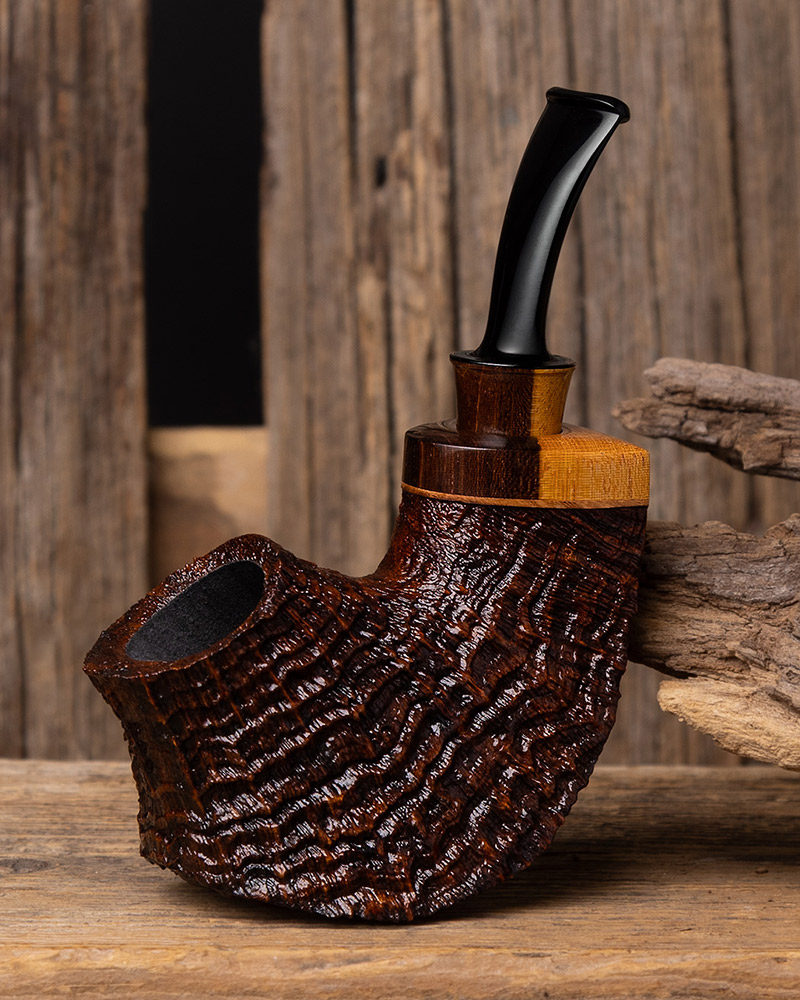
Bill Shalosky: Sandblasted Volcano with Suriname Ironwood
Bill Shalosky, American craftsman and one of the artisans behind BriarWorks Pipes, submitted a sandblasted Volcano accented with Suriname ironwood.
The pipe features a deep, rich, prominent sandblasted finish that accentuates the ring grain, and a pronounced sweep to the underside of the bowl that emphasizes the depth and muscularity of the Volcano shape. Subtle details round out the design, including a plateau bordered by ridges on either side that reinforce the pipe's lines, and an asymmetrical two-tone color palette on the accent that draws out the finish on the bowl, particularly around the base.
A short, subtle stem keeps the visual emphasis on the stummel, while a swooping ridge along the rim lends the piece a strong sense of forward momentum. Another excellent showing from Bill.
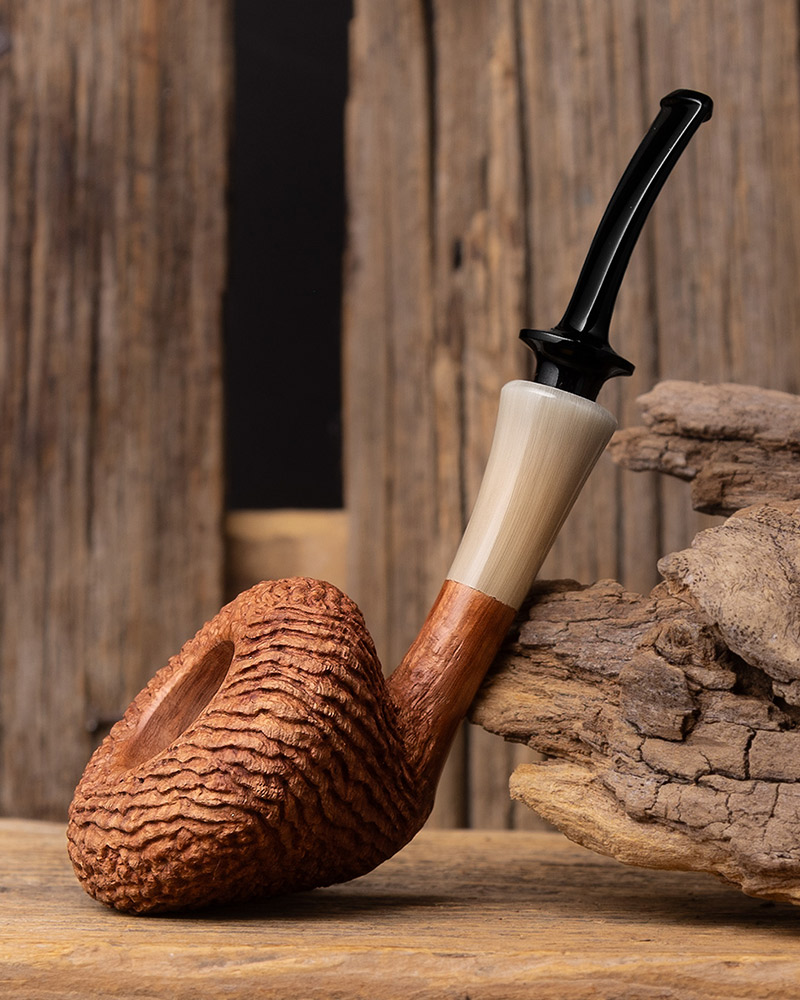
Wandi Riyadi: Sandblasted Fig with Horn
Indonesian carver Wandi Riyadi submitted a beautiful Fig rendition, left unstained in its natural state, which suits the piece well. The horn used for the extension is some of the finest we've seen, culminating in a Danish-style military mount with a brass ring.
Wandi carved the Fig and then sandblasted over the finished shape, resulting in a playful, wholly distinctive texture unlike anything else in the collection. Paired with his inventive shaping style, it makes for a wonderful, one-of-a-kind piece from one of the most imaginative carvers working today.
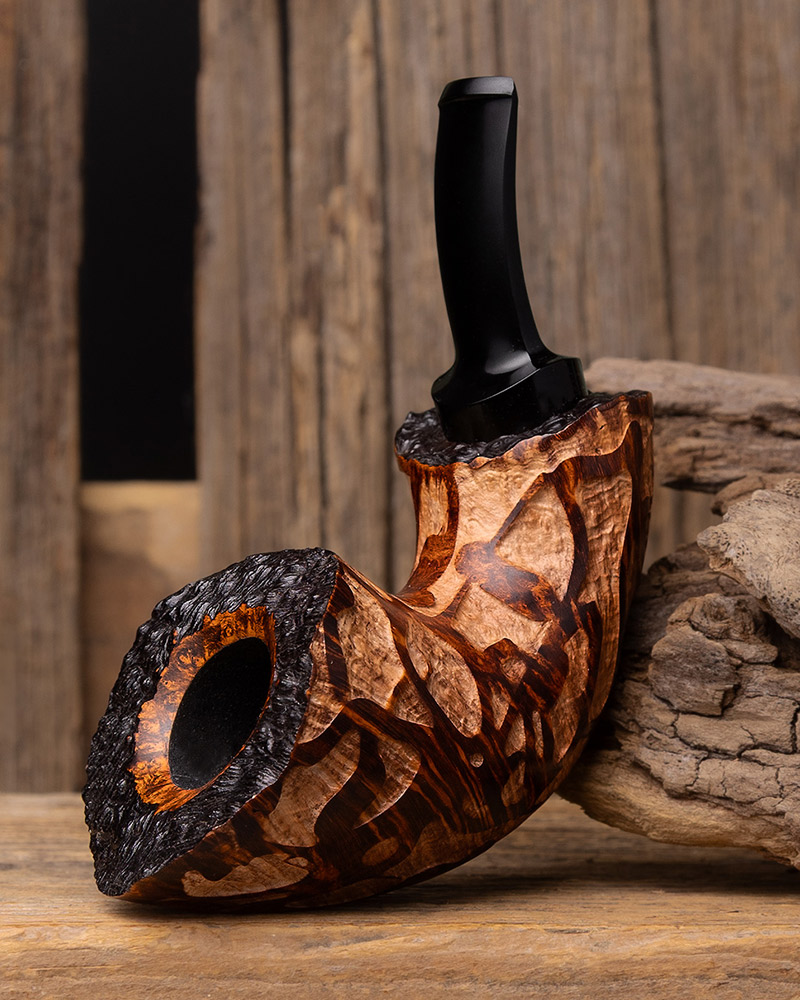
Christian Ruetz: Partially Sandblasted Bent Dublin
Christian Ruetz's bent Dublin calls to mind the work of modern artists like Jackson Pollock — the kind of splatter-and-swing technique familiar from viral art demonstrations, rendered here in briar.
Christian shaped a smooth pipe, masked portions of it, and then sandblasted the surface to reveal added texture, producing a bold, striking contrast. A plateau rim and matching plateau at the shank end complete the effect. The bowl itself is slightly more compact and muscular than a typical bent Dublin, with chunky proportions and striking rivers of grain throughout.
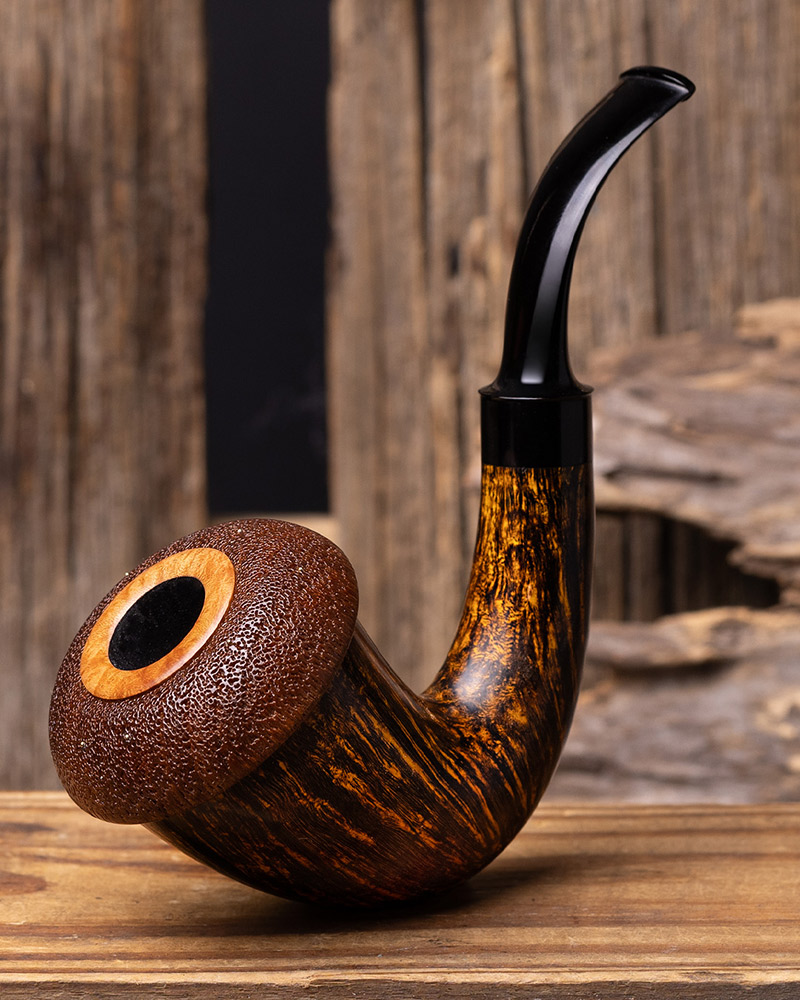
marTelo: Smooth Calabash with Sandblasted Sucupira and 18k Golden Dots
Brazilian carver Gustavo Cunha, of marTelo Pipes, submitted an elegant Calabash with a smooth-finished body. For the sandblasted element, he chose sucupira wood, a species native to South America, rather than briar — an interesting departure that yielded a strikingly three-dimensional texture once blasted.
Gustavo added 18-karat inlays to the cap as a finishing touch. Notably, this is the first Calabash he has made.
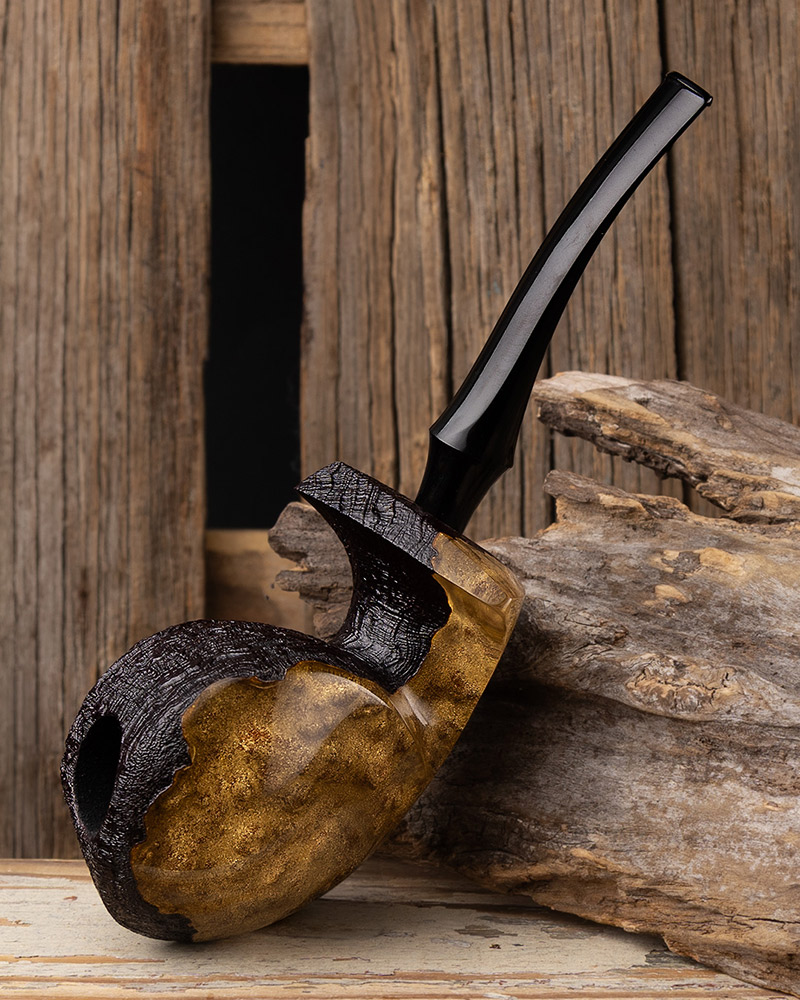
Adam Davidson: Sandblasted Cosmic Goldfish and Sandblasted Brandy Mirage
American artisan Adam Davidson submitted two pipes this year. The first extends the cosmic theme he has explored for several years — a large, intentionally asymmetrical piece, and the first Cosmic on which he has used gold cosmic dust: 24-karat gold foil, ground by hand and applied to the briar in several layers.
When selecting the block, Adam looked for briar that would sandblast away cleanly, and found an exceptional piece in which the softer material fell away entirely, leaving behind a texture reminiscent of moon rock, craterous and dramatic — a look the gold dust plays against beautifully. Shaping a sandblasted Cosmic Blowfish requires anticipating the asymmetry of the final form before it is complete, which makes the result especially impressive. A longer, sleeker stem than usual offsets the bowl's inherent bulk, and beneath the cosmic elements, the ring grain is exceptional and cleanly framed by the panel work.
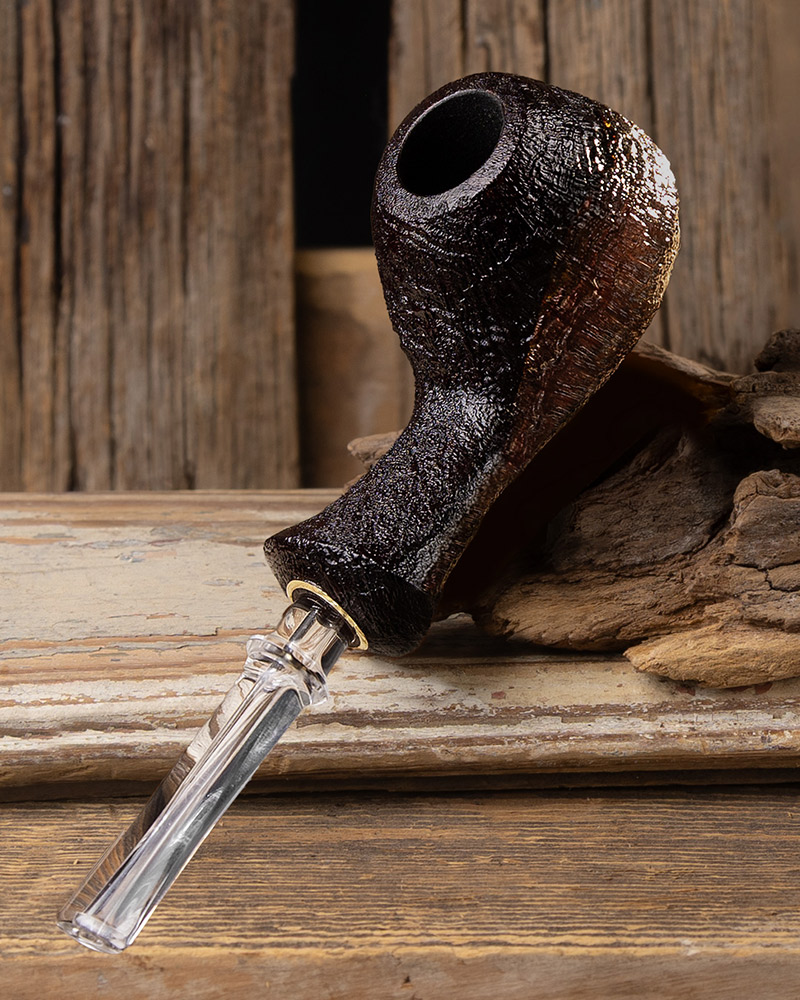
Adam's second entry is an asymmetrical Brandy fitted with a strikingly clear, unfrosted acrylic stem that he handmade himself, going so far as to polish the interior of the draft hole so it remains visible straight through. The stem carries a beautiful, almost ice-toned color, but the pipe conceals a deliberate trick: the draft hole inside the bowl appears slightly off-center, though it is not. The entire right side of the pipe is actually cast resin — indistinguishable from briar to the eye, and detectable only under a spotlight.
To achieve the effect, Adam shaped and finished the pipe exactly as intended, cast a mold of the sandblasted texture, then cut the piece on the bias and stained the newly cut side to match, so that the resin catches light as though it were part of the same continuous piece of briar. This is the first pipe in a new line Adam calls The Mirage — a fitting name for a piece that reads, at first glance, as a familiar Adam Davidson design, until closer inspection reveals the illusion.
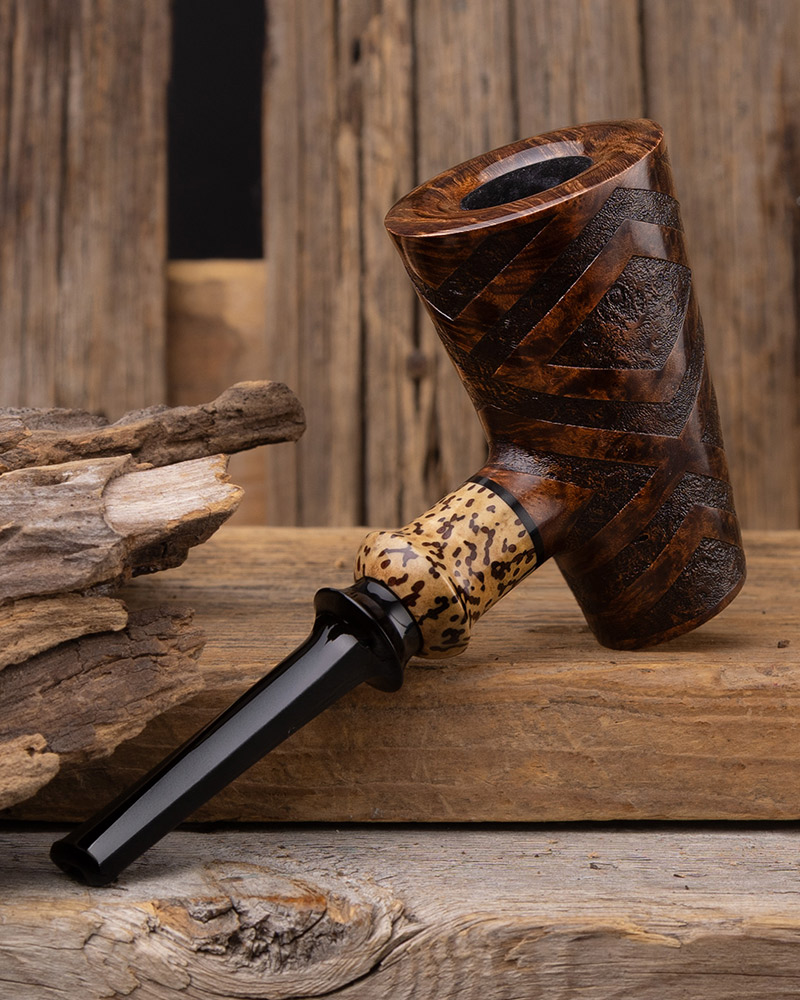
Luiz Lavos: Partially Sandblasted Poker
Brazilian carver Luiz Lavos submitted what may be the most distinctive finish in this year's Exposition: a rendition of a Poker that alternates smooth and sandblasted textures to evoke the basket weaving of Brazil's indigenous tribes.
As light moves across the contrast between blast and polish, the level of craftsmanship becomes especially apparent. The piece is paired beautifully with Jupati, a material that has become something of a signature accent among South American carvers, resulting in a piece quite unlike anything else in the collection.
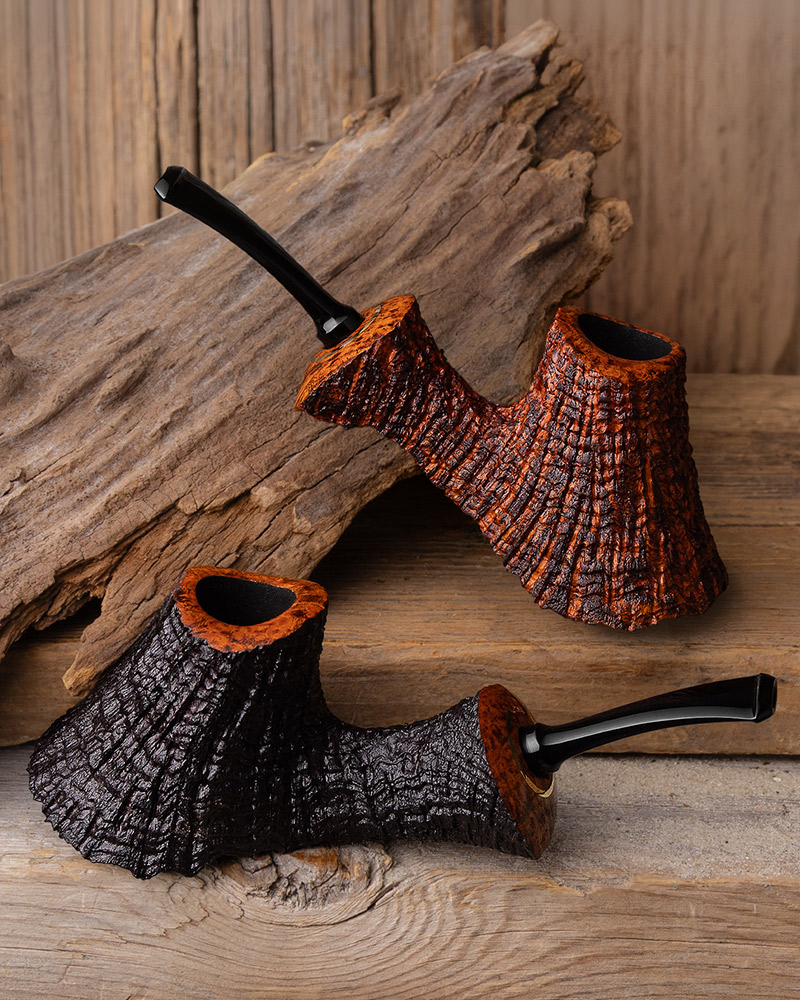
David Huber: Strawberry Volcanos Box Set
North Carolina carver David Huber, known for pushing the boundaries of style and form, submitted a two-pipe set in a custom collector's box: a pair of strawberry Volcanoes that emphasize a forward sweep at the foot of each bowl.
Both pipes feature a prominent, textured, craggy sandblasted finish, with the rim and mortise area left smooth and subtly accented to set off the color palette. A tapered shank reinforces the boldness of the shape, and the matched pattern across both pipes results in a cohesive, well-executed set, finished with a prominent, slightly asymmetrical plateau at the base of each bowl.
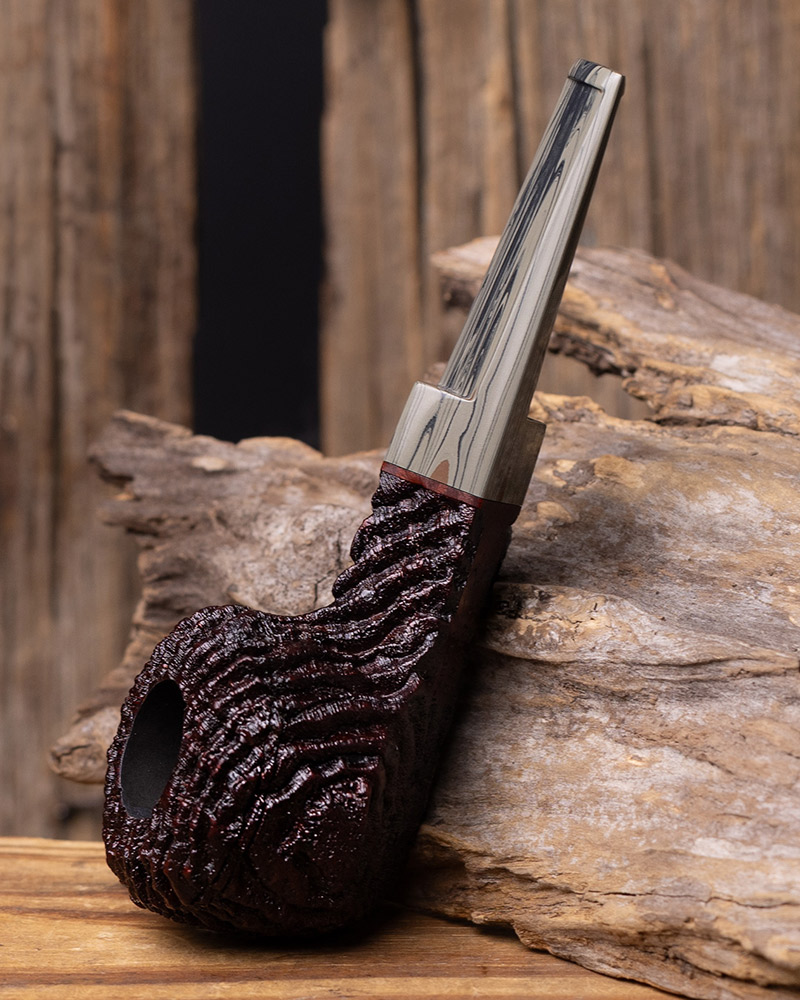
Michael Parks: Gnarly Sandblasted Bulldog
When the conversation turns to sandblasting, Michael Parks is one of the first names that comes to mind, and his entry for this year's Exposition shows why.
His robust Bulldog features an exceptional blast, deep and well defined, with the lines of the shape carefully preserved throughout. What makes it especially notable is that Michael, no stranger to ring grain or sandblasting, chose a shape that is notoriously difficult to blast evenly given its geometric structure, and still produced one of the most dynamic sandblasts of his career. Photos do not do it justice — fittingly, the pipe has been stamped "Gnarly," a description it fully earns.
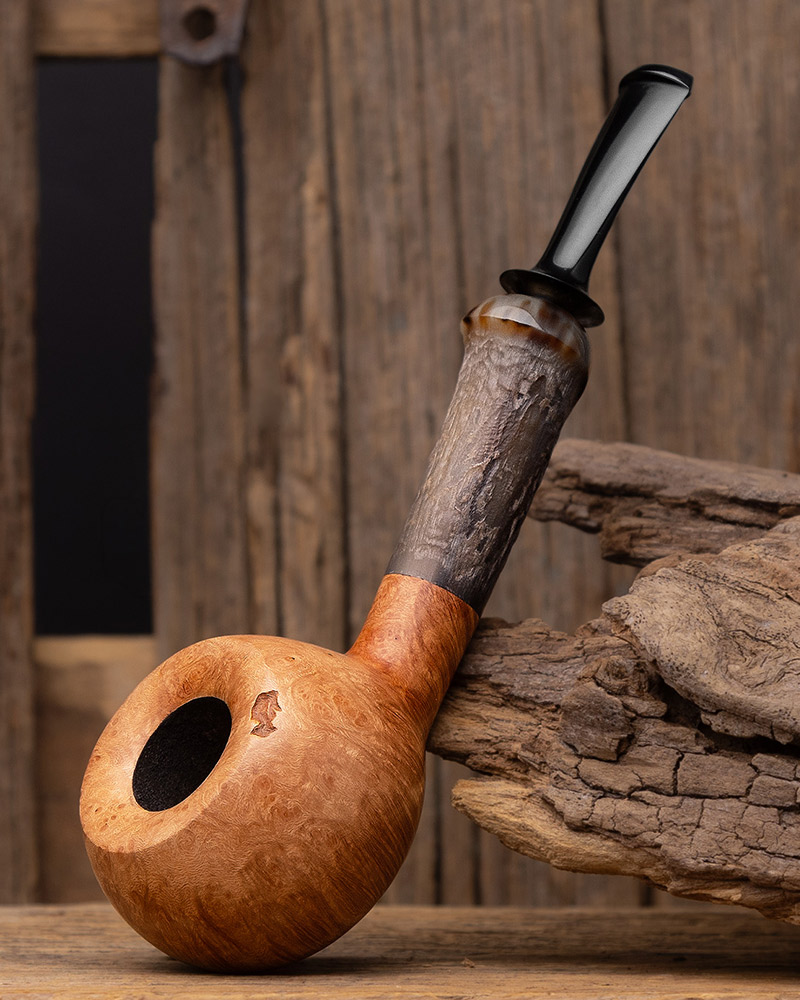
Austin Quinlan: Smooth Tomato with Carved and Sandblasted Horn
Austin Quinlan's smooth Tomato stands out for its overall matte finish. While the bowl itself remains smooth, Austin introduced texture through the long horn ferrule, which he sandblasted, lightly rusticated, and sandblasted again.
The result is a matte, weathered look reminiscent of something found in the wild. A smooth, polished scallop at the end leads into the vulcanite stem, offering a hint of shimmer and gloss against the texture of the horn — an interesting application of sandblasting outside the bowl, with an effect that carries cleanly through the shank.
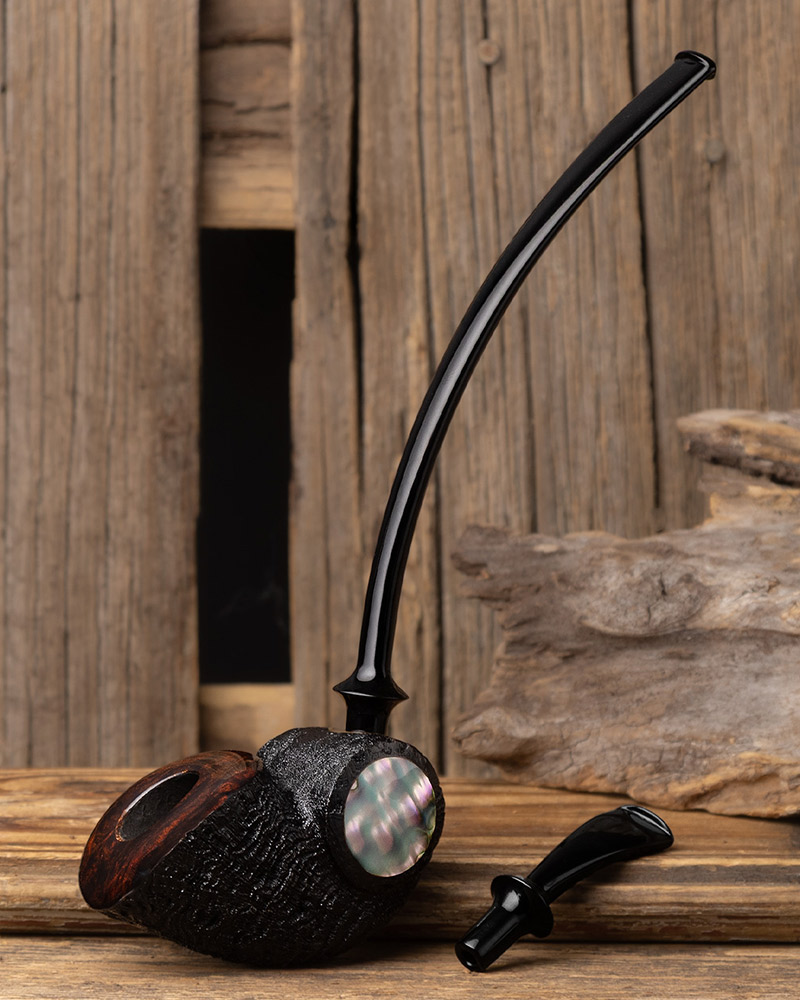
Jay Mouton: Sandblasted Nautilus with Abalone
Louisiana pipe maker Jay Mouton submitted a sandblasted Nautilus with an abalone accent set on one side only, leaving smooth briar on the other, a choice that accentuates the natural asymmetry running through the shank.
A wavy ring-grain pattern and prominent blast pair with a smooth rim for a striking contrast in both finish and color. The pipe also comes with a second interchangeable stem, effectively offering two distinct silhouettes and visual effects in one piece — in either configuration, the asymmetry makes for a compelling design.
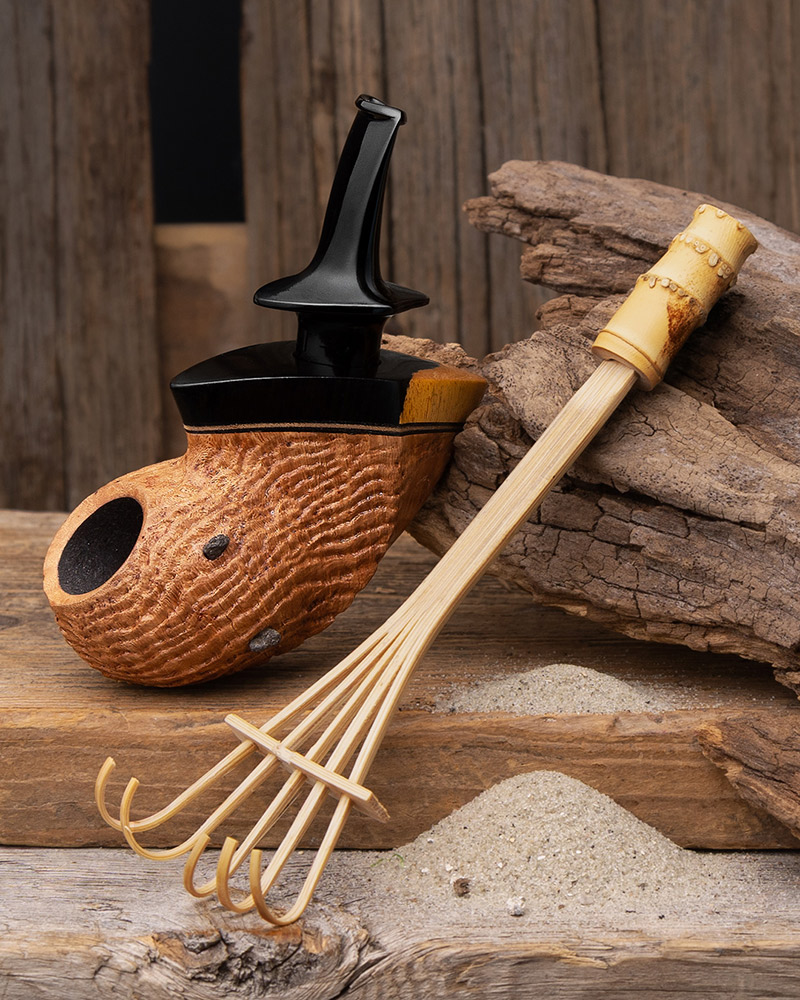
Dirk Heinemann: Sandblasted Dora Zen Garden
Renowned German artisan Dirk Heinemann submitted a beautiful rendition of the Dora, a shape that has become something of a signature for him. For this piece, Dirk drew inspiration from the Japanese philosophy of wabi-sabi, which, rather than concealing briar's natural imperfections, embraces the wood's history as part of its beauty.
Beyond a stunning ring grain pattern in the sandblast, Dirk designed the piece to evoke a zen garden, aptly the name he gave it. Three stones represent the stones found in such a garden, while the sandblast itself evokes the look of freshly raked sand. A bamboo tamper, reminiscent of a zen garden rake, rounds out the theme. It is a distinctive, carefully considered piece that longtime admirers of Dirk's work will immediately recognize.
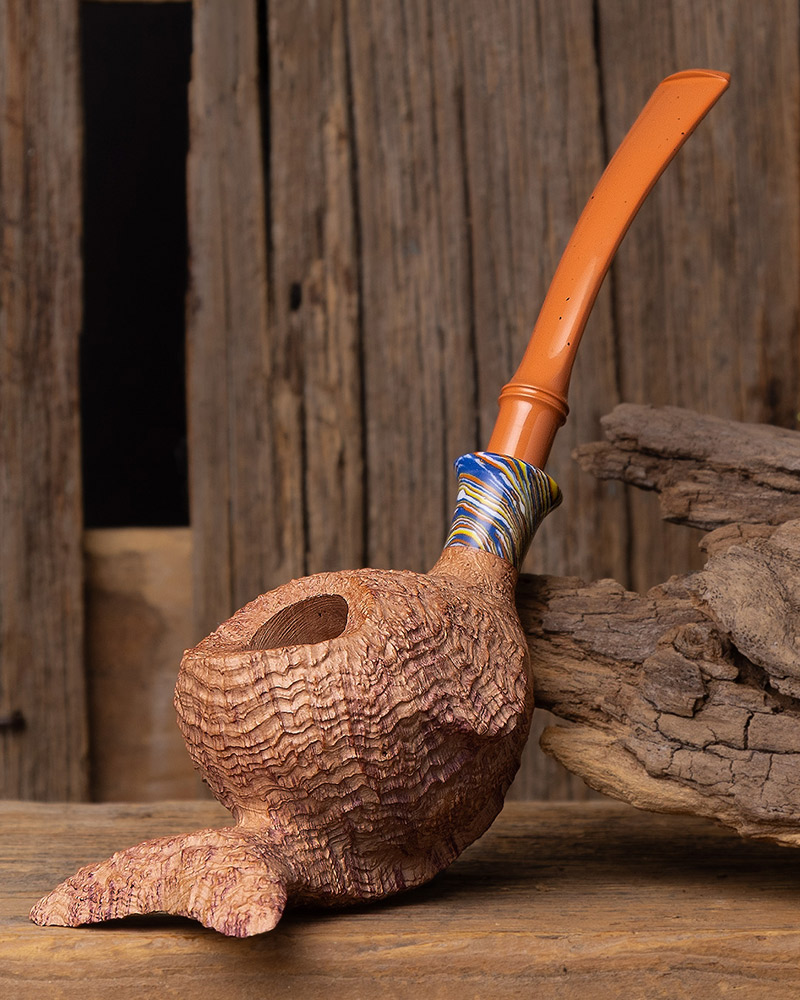
Giacomo Penzo: Sandblasted Fish with Resin
Giacomo Penzo's entry is a standout: a more sculptural Freehand than his work typically favors. He calls the shape a Fish, though it is a far more figural interpretation than is often seen from Danish carvers, with a pronounced tail, a muscular yet finned bowl, and gentle scalloping along the rim.
It is a dynamic, sculptural shape offering multiple surfaces for sandblasting to play across, revealing ring grain, hints of flame, and birdseye along the tail and base. The natural, minimally stained finish is offset by a striking multicolored resin mount, which provides sharp contrast against the bowl's more rugged expression, finished with a salmon-colored vulcanite stem.
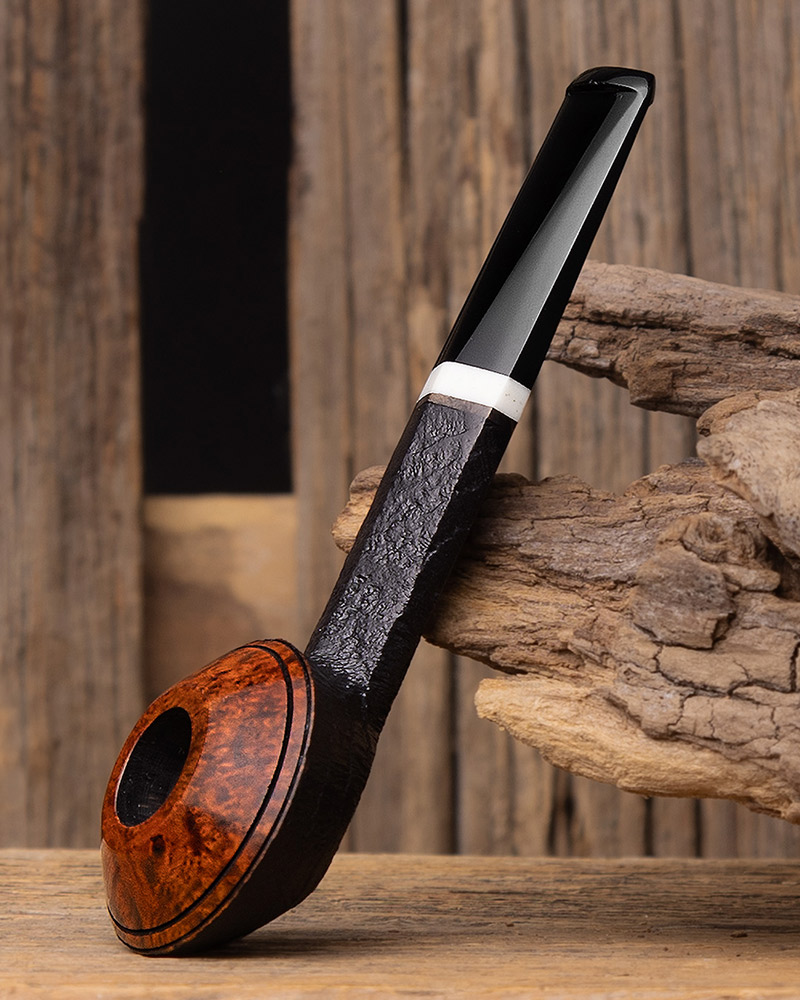
Manduela: Partially Sandblasted Mini Bulldog with Bone
Danish pipe maker Manduela submitted a partially sandblasted mini Bulldog with a bone accent. The Bulldog is one of her signature shapes, and she is well known for her preference for smaller pipes, both as a carver and a collector.
A subtle, lightly textured blast covers the shank and underside of the bowl, while the top half remains smooth above the beadlines, resulting in a striking silhouette in a small, compact size. The squat bowl lends the piece an almost flat profile, a distinctive, unmistakably Manduela design.
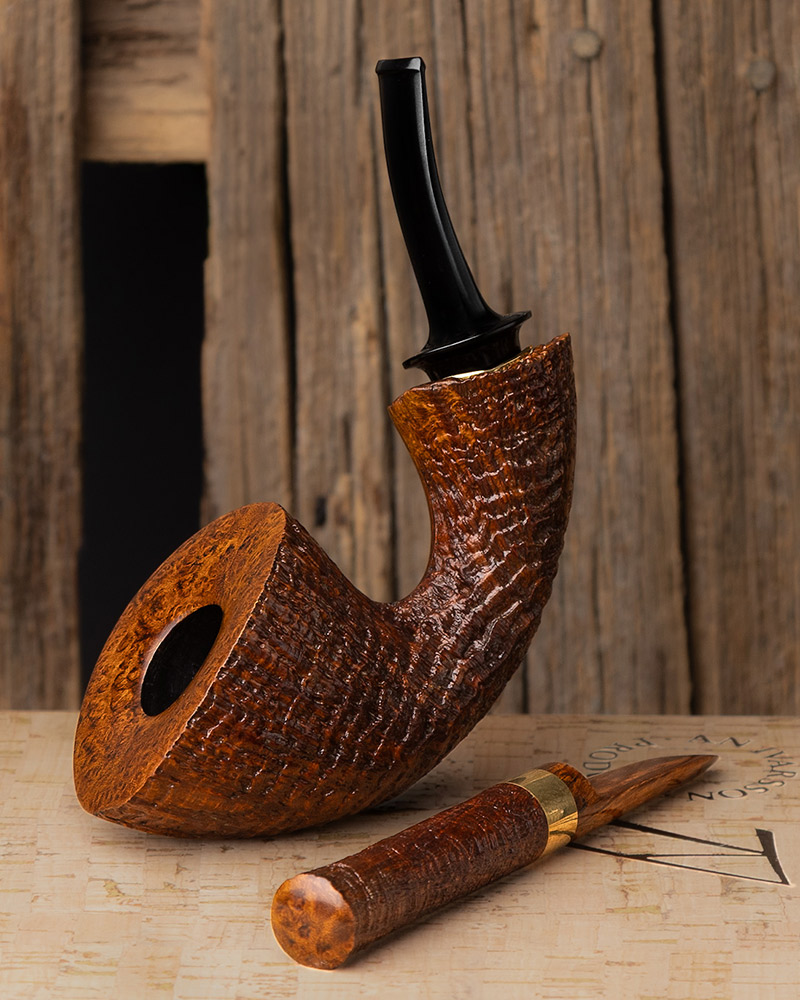
Nanna Ivarsson: Split Finish Bent Dublin
Nanna Ivarsson took on the challenge of doing something extraordinary with a sandblasted finish by creating a piece she had never attempted before: a dual finish that showcases the contrast between smooth and sandblasted grain within a single pipe, effectively a literal cross-section of both textures.
The grain and shaping are both exceptional, resulting in a genuinely unique piece she is unlikely to repeat. The pipe comes with a fitted box and a matching tamper that also incorporates both finishes — an impressive piece, both for the contrast between textures and the quality of the shaping.
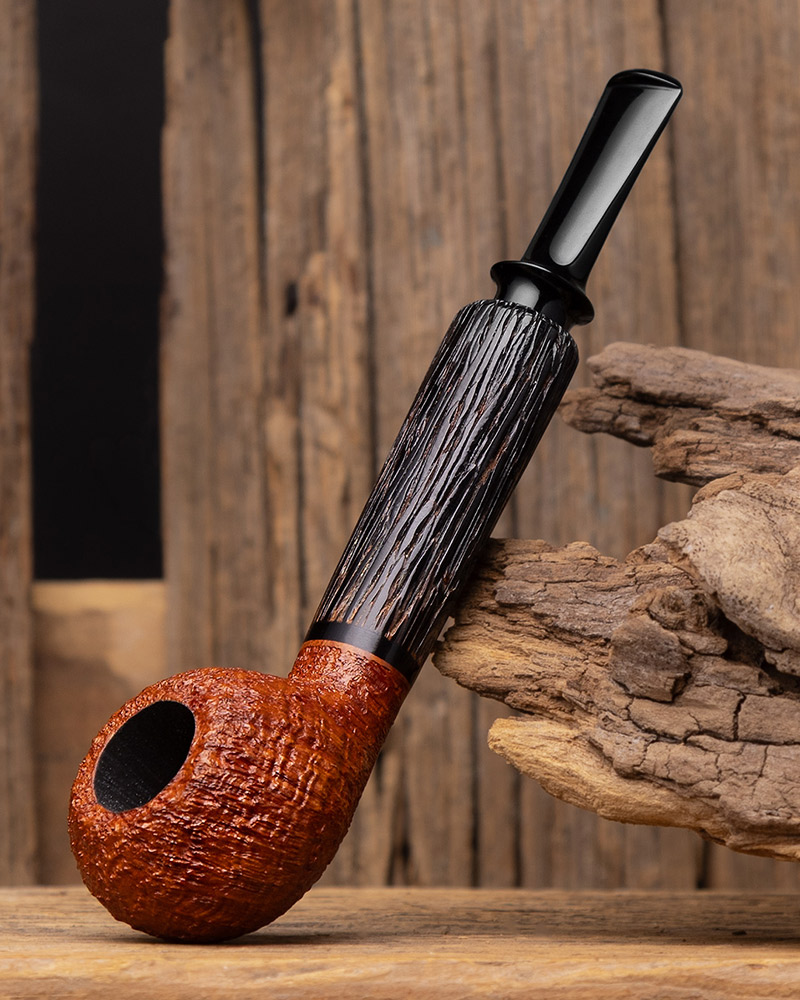
Micah Redmond: Sandblasted Tomato with Black Palm
Micah Redmond's entry takes an approach rarely seen: sandblasting the pipe's long black palm shank accent. The piece is a playful variation on a Tomato, a shape Micah is well known for, rendered here in a squatted form with an extended shank in a different material.
Sandblasting the accent creates a striking variation in both color and visual concept. The blasted black palm is deeply craggy, with pronounced crevices that pair well with a jet-black stem and a lighter stain on the bowl. The bowl's own sandblast is shallower by comparison, showing off pronounced growth rings — a genuinely interesting piece and, for admirers of Micah's work, an excellent addition to any collection.
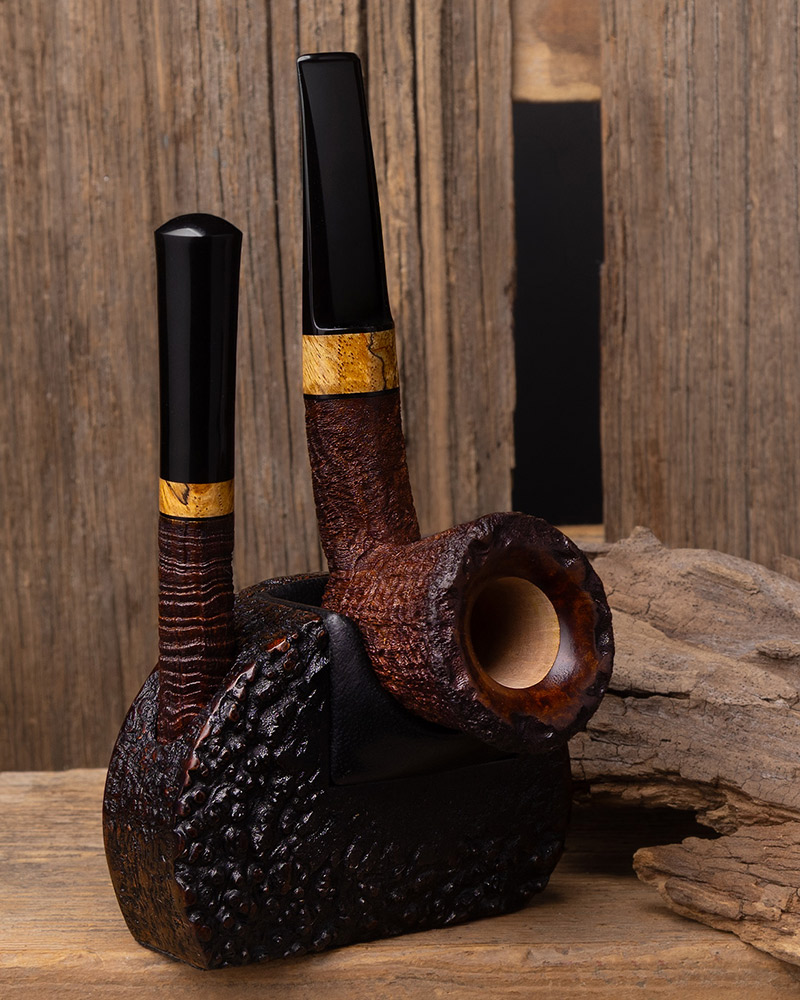
Ryan Alden: Sandblasted Bent Dublin with Spalted Pecan
Texas pipe maker Ryan Alden submitted a sandblasted bent Dublin with prominent, striking ring grain accentuated by the blast. Natural asymmetries near the rim frame a smooth surface there, while a sweeping line down the shank leads into the stem, accented with spalted pecan.
Ryan also crafted a custom tamper to accompany the piece, featuring its own prominent blast and matching accent, along with a small stand — making this pipe a self-contained set, and a distinctive, well-rounded entry to this year's Exposition.
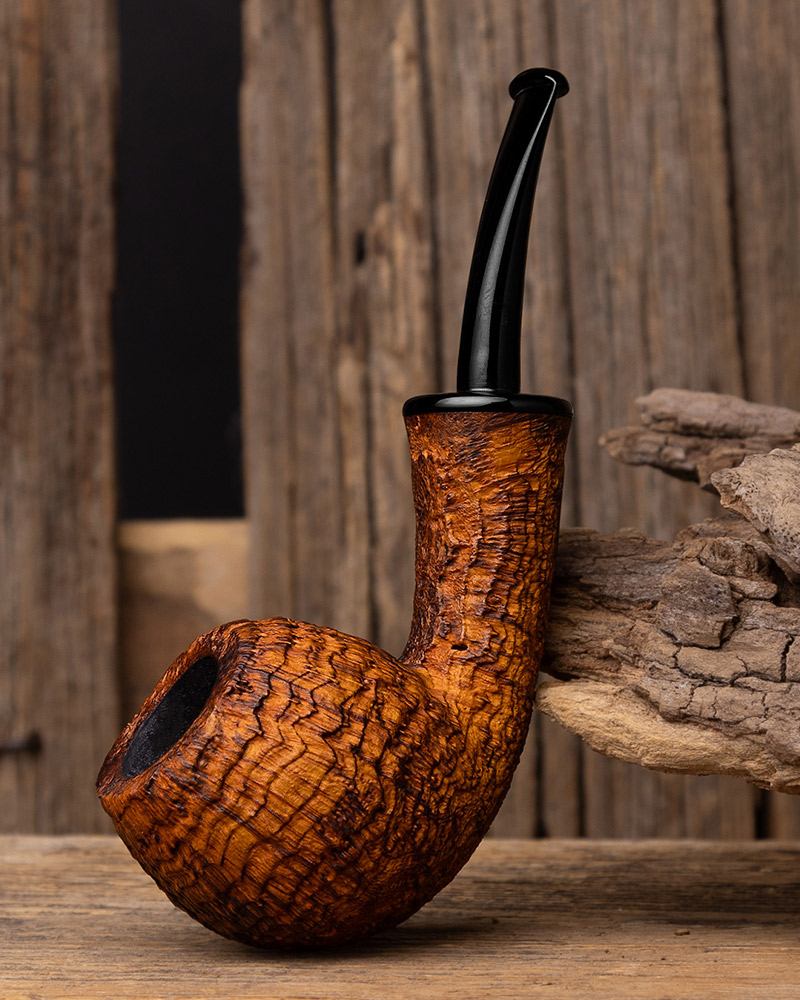
Il Duca: Sandblasted Bent Apple
Il Duca's submission is an instantly recognizable bent Apple, with a slightly flared shank and a touch of asymmetry and bevel to the bowl that lends it an organic quality.
The sandblast features broad swaths of ring grain that resemble overlapping layers of lava, complemented by Il Duca's characteristically organic contrast stains: a hint of smokiness paired with dark, burnt orange and burgundy tones that absorb unevenly into the briar for added depth. A striking swath of sandblasted birdseye on the shank calls to mind moon rock, echoed by a similarly craterous effect on the base of the pipe — an exceptional example of Il Duca's sandblasting work.
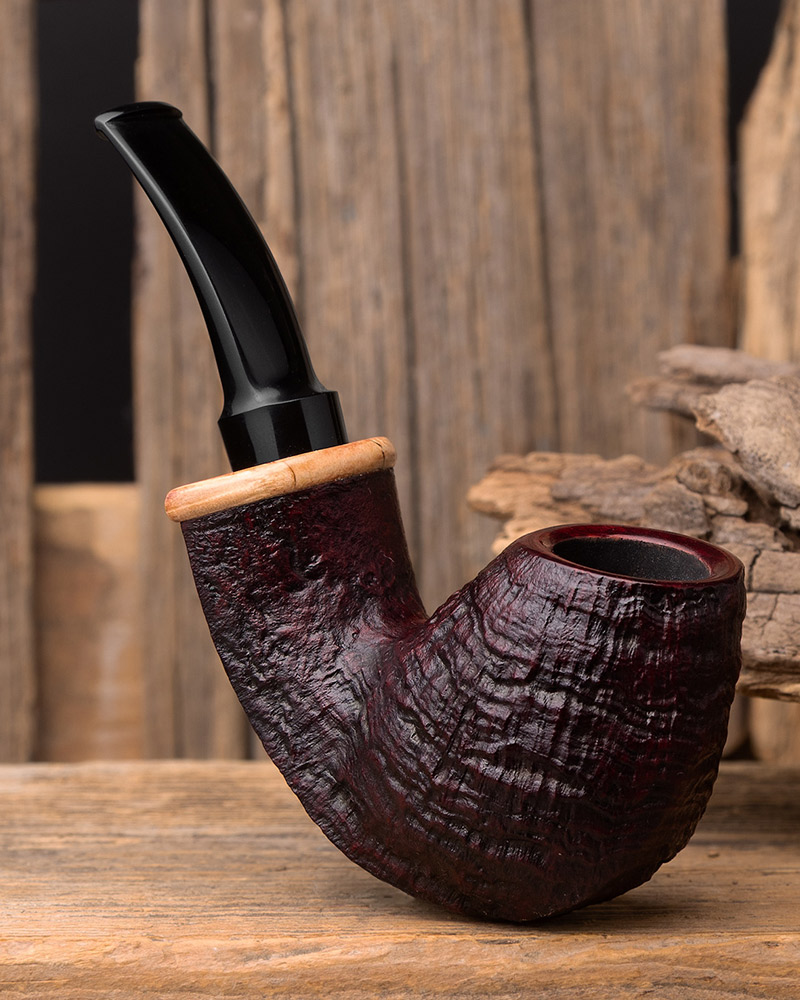
Brad Pohlmann: Sandblasted Lars Blowfish with Masur Birch
Brad Pohlmann's entry is a large-style Blowfish, a dynamic shape that serves as an excellent canvas for sandblasted grain.
The sandblasted finish Brad achieved on this block of briar is exceptional. A veteran of the sandblasting cabinet, his style straddles the line between classic Danish-style blasting and the more aggressive American approach, preserving the lines of the shape while adding real depth and detail. A masur birch accent completes a classic, well-executed piece.
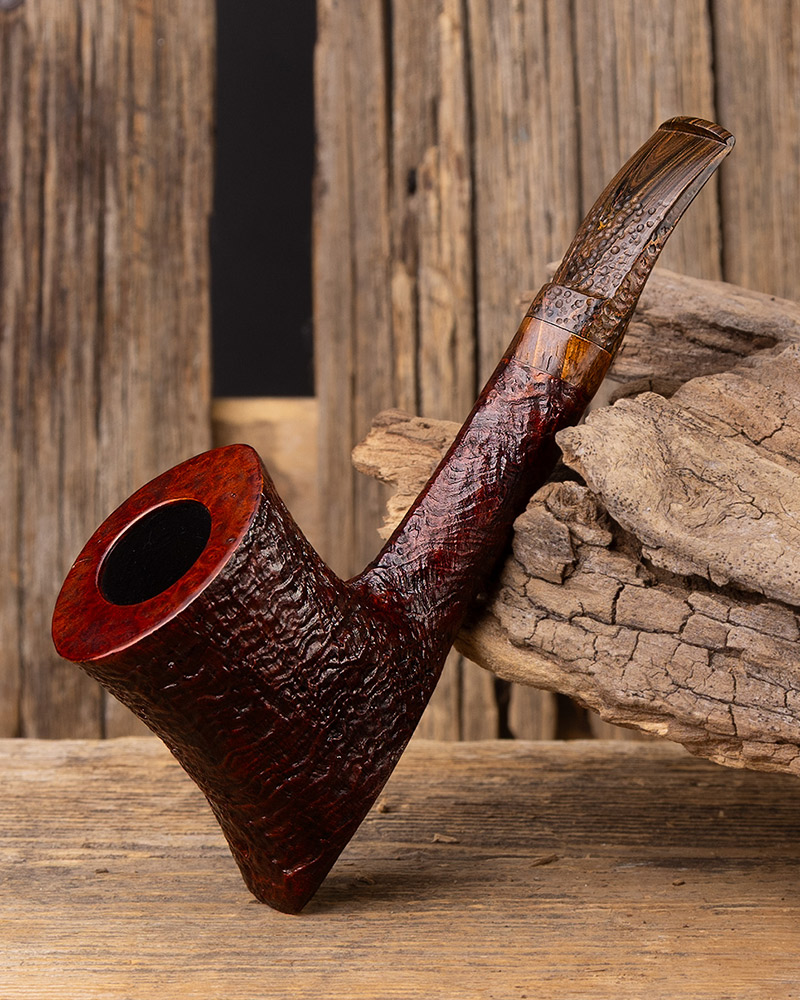
Silver Gray: Sandblasted Skater with Tiger Wood
Silver Gray submitted a sandblasted version of a Skater, with playful, inventive shaping throughout — a hallmark of Silver's approach to classic shapes.
The stummel features a beautiful ring blast with especially pronounced growth rings, and was carved from a block sourced from J.T. Cooke, one of the most recognizable names in artisan sandblasting. The piece also features a tiger wood accent and an ebonite stem, both textured through a combination of sandblasting and rustication, creating a playful interplay between the stem, the accent, and the classic ring-grain blast on the stummel.
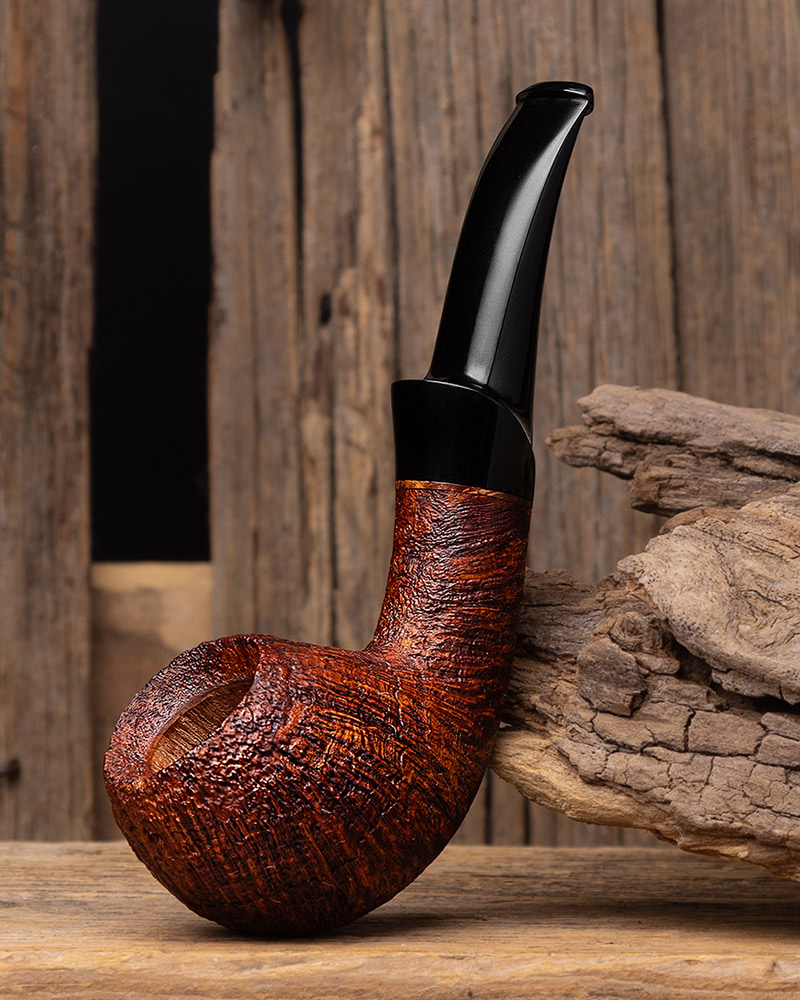
Scott Thile: Sandblasted Bent Egg
Scott Thile's entry is a dynamic bent Egg shape, with a sweeping line beneath the bowl leading into the stem and a slight cant that lends the piece forward motion, reinforced by the half-saddle stem's subtle, fin-like profile.
Scott's sandblasts tend to run lower-profile, and this block of briar is beautifully oriented with flame grain. His contrast-stain sandblast preserves both the rising swaths of flame grain and tight ring grain around the bowl, while a deep bevel adds sharpness to the profile and should allow the pipe to pack especially well.
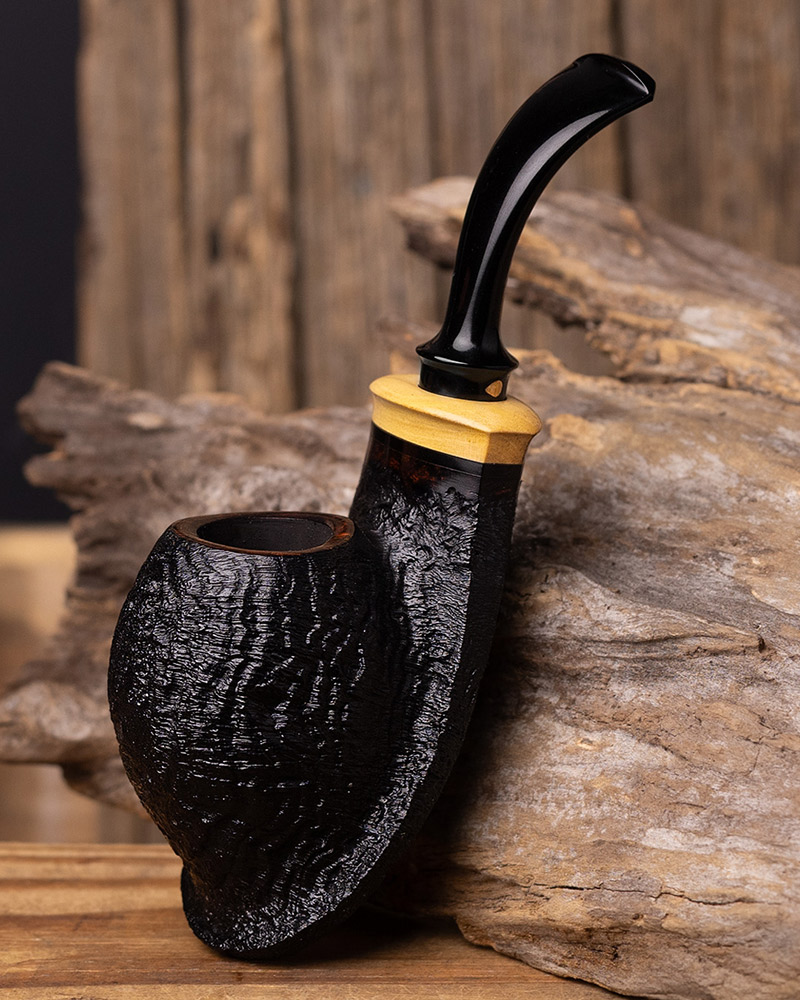
Tine Balleby: Sandblasted Ramses with Boxwood
Tine Balleby's entry is a Ramses, a shape well known to the Balleby family and originally coined by Bo Nordh himself. The choice is a particularly interesting one: the grain orientation produces a wide swath of sandblasted birdseye on the back of the pipe and ring grain running front to back across the bowl, a complex, technically demanding shape rendered here with a sandblasted finish that highlights grain in an unusual orientation.
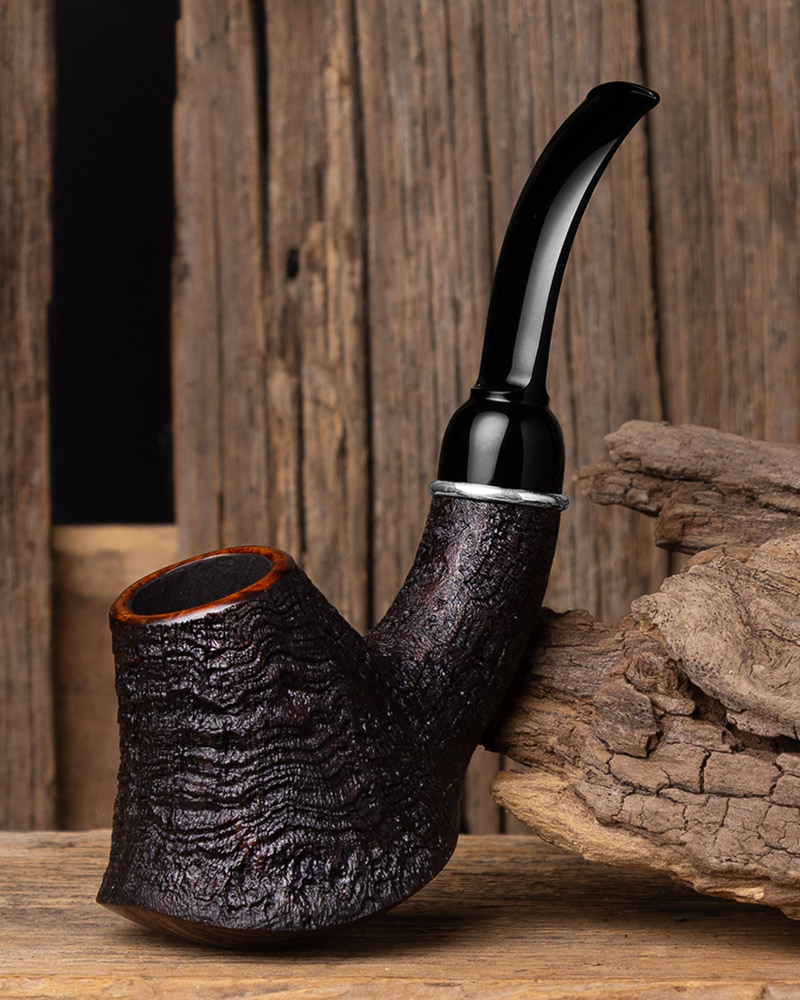
Trey Rice: Partially Sandblasted Volcano with Silver
Texas pipe maker Trey Rice, who began his career as an architect, has often drawn parallels between the interplay of form and function in architecture and in pipe making, and this piece reflects that sensibility.
It is a striking take on the Volcano shape, featuring a double wave through the stem and shank that flows into a pronounced fore, a domed saddle stem, and a subtle, tastefully refined silver accent. The ring grain in the blast is wavy and asymmetrical in ways that make the pipe especially distinctive, while a narrow, smooth section on the rim echoes a more prominent smoothness at the base of the bowl.
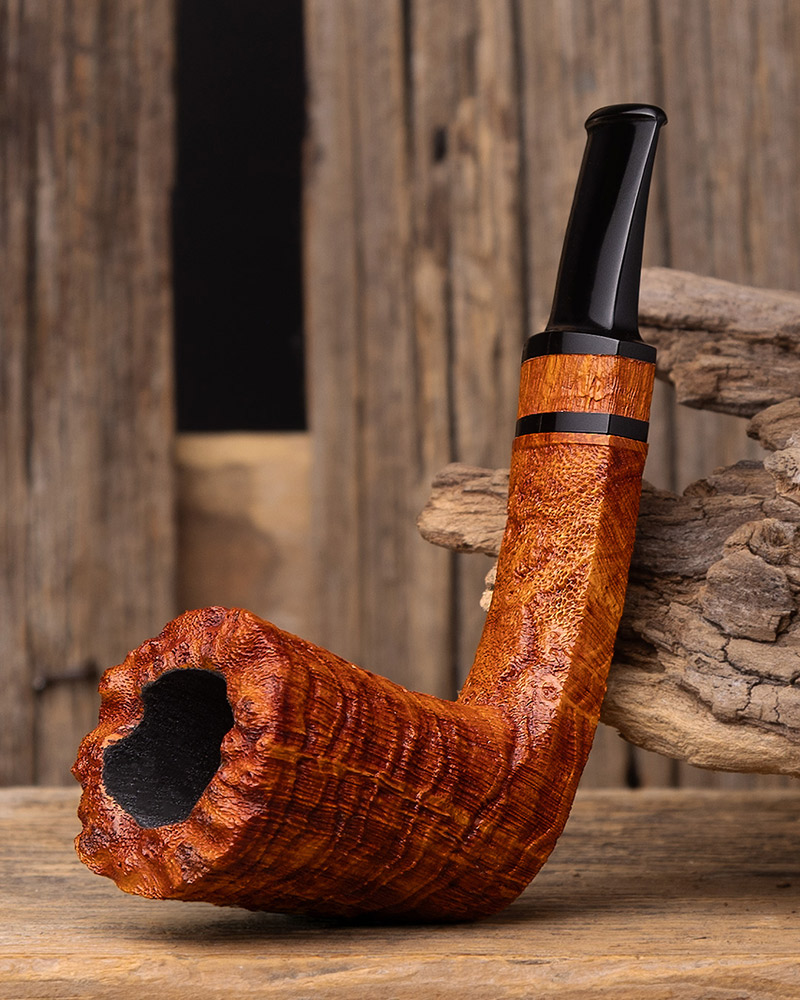
Pete Prevost: Sandblasted Bent Dublin
Tennessee carver and BriarWorks artisan Pete Prevost submitted a paneled-shank Dublin with a plateau rim, a shape he returns to often, rendered here in a particularly compelling variation.
The sandblast is exceptional, drawn from especially well-aged briar, with pronounced, craggy ring grain. The shank carries a softer, surface-level blast, while a briar ring embedded in the stem has also been sandblasted for added variation in texture; even the plateau has been softly blasted for depth. The range of textures gives the piece considerable visual interest — well done, Mr. Prevost.
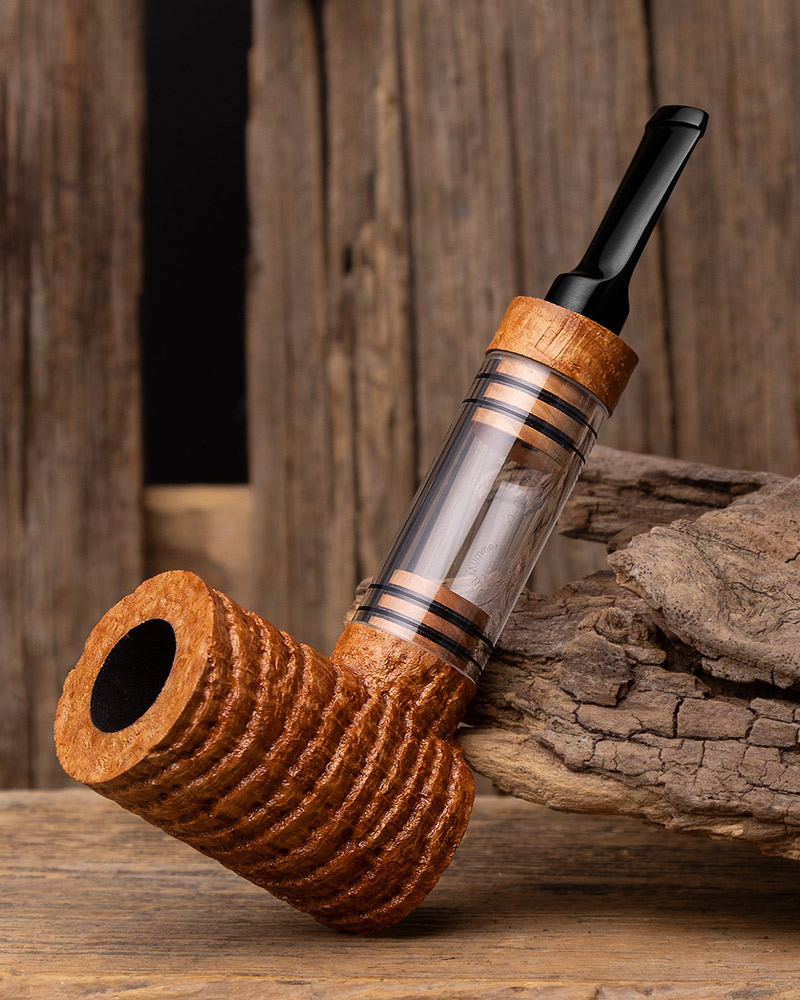
Werner Mummert: Sandblasted Reverse Calabash Poker
Werner Mummert's submission is an instantly recognizable piece: his signature reverse-Calabash Poker, pairing a traditional Poker silhouette with reverse Calabash engineering.
What stands out most on this model is the transparency of the shank, which allows the smoke itself to be seen passing through, a novel touch that remains fully functional. The sandblast is excellent: rather than a contrast finish, the block reveals enough natural texture to show striations of flame grain running beneath deep, cresting waves of ring grain, with a slight natural undulation across the bowl. The result is an industrial-looking shape balanced by the organic character of the grain — an exceptional piece from Werner.
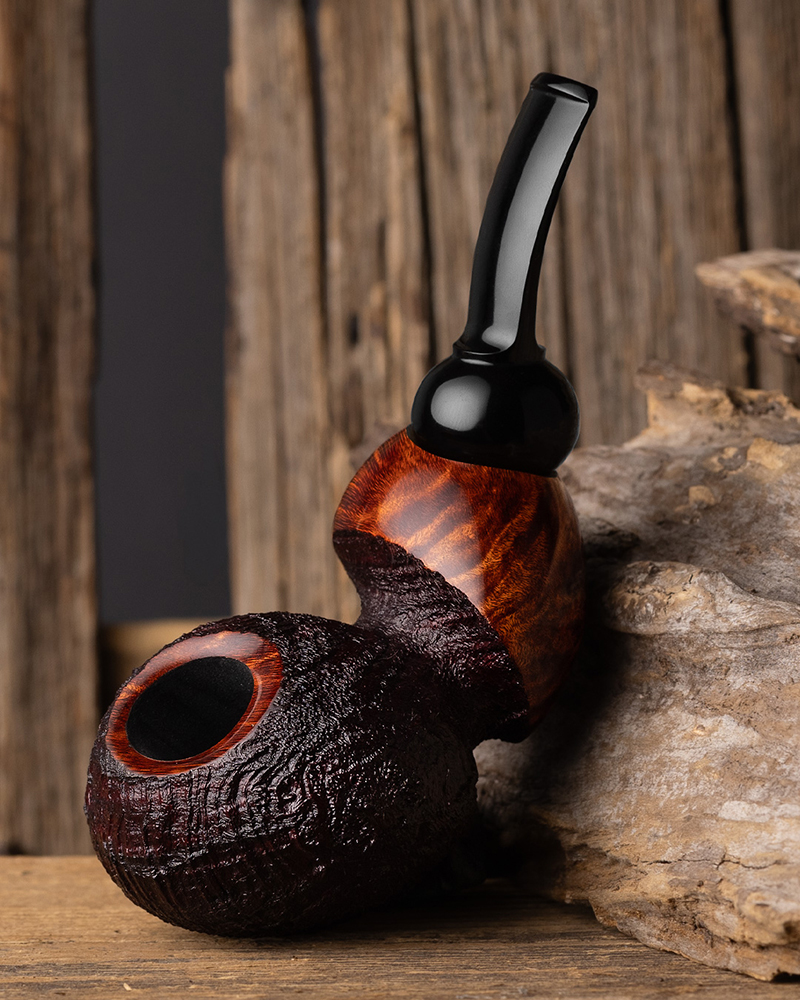
J. Alan Partially Sandblasted Ant
J. Alan's entry for this year's Pipe Exposition is this partially sandblasted Ant, a sculptural form that stays true to its namesake. The design is divided into three distinct sections, with the head set along the shoulders of the stem and two rounded sections forming the body of the ant: the bowl and shank. The stem extends outward like an antenna, completing the likeness. The bowl takes on an organic, asymmetrical form, with much of its surface left sandblasted to showcase the natural texture of the briar and call back to the Expo's theme. The shank follows a similarly bulbous shape but is left smooth, providing a striking contrast to the blasted bowl. The stem echoes the rounded form of the head, with a matching bulbous shape and rounded base. Throughout the piece, the grain is brought to the forefront, with the contours of the bowl following the sandblasted growth rings to create a highly textured surface. A true one-of-a-kind creation, the Ant showcases Gracik's willingness to push his sculptural approach in unexpected directions while maintaining the clean sensibility found throughout his work.
Our thanks again to every pipe maker who submitted an entry to this year's Global Pipe-Making Exposition: The Art of the Sandblast. We hope you find the collection as compelling as we did.
You may also enjoy:


Comments